



A qualified candidate asks a simple question on her second call: which territories are open near Nashville, and what exactly would I own? Your rep says he will check with operations and get back to her. Three days later she gets a PDF with a hand-drawn circle around a ZIP code. That is the moment many franchise deals slow down. Franchise territory mapping is how a franchisor defines, packages and shows territories so a candidate can see what they are buying and say yes. This guide covers how to build territories that hold up, how they connect to Item 12 of your FDD, and how to present them so they help close deals instead of stalling them.
Key Takeaways
- Good franchise territory mapping starts with the unit economics: how many customers or households one location needs to succeed.
- Item 12 of the FDD must describe the territory you grant, and the FTC Franchise Rule requires specific language if the territory is not exclusive.
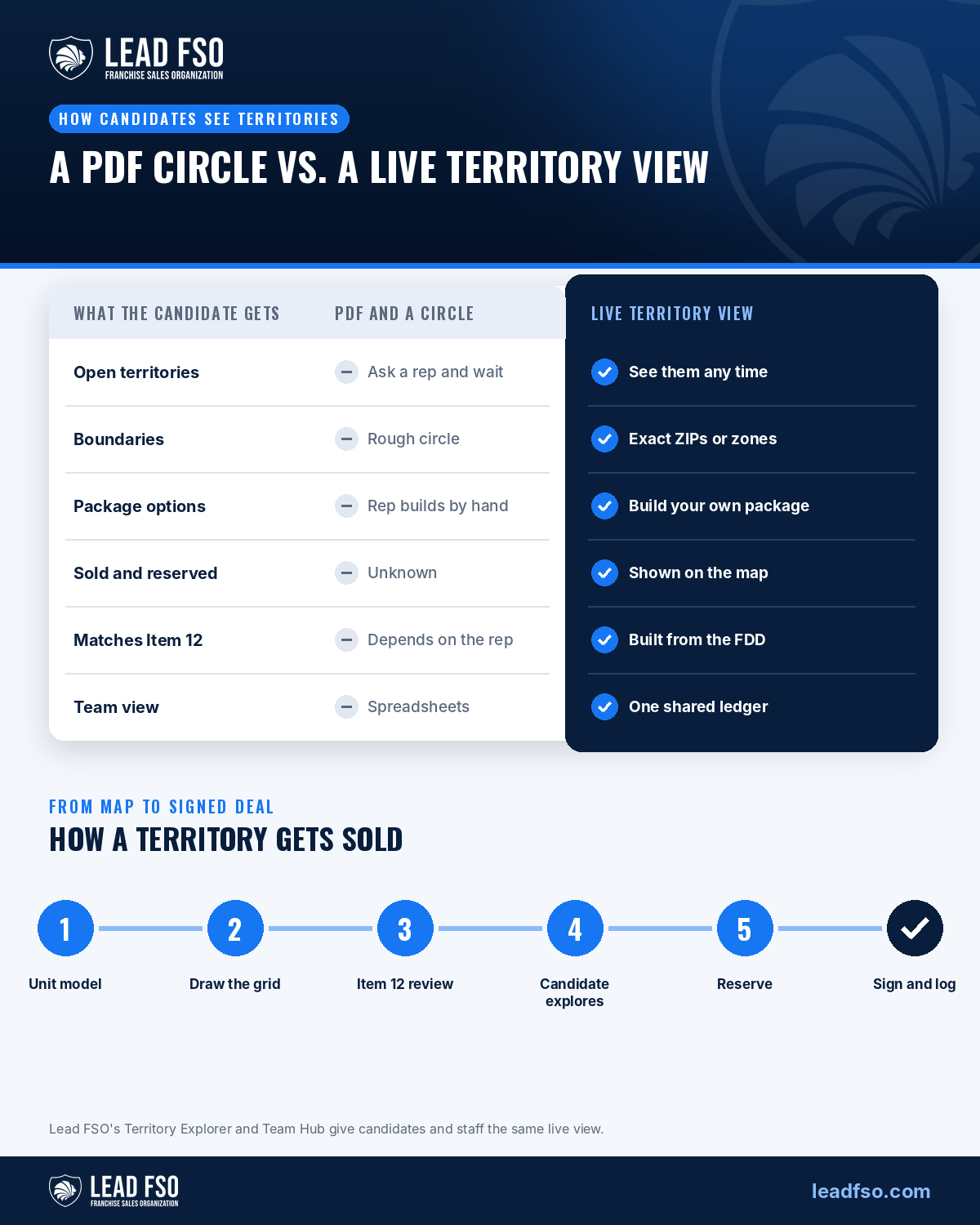
- Candidates buy faster when they can see open territories, boundaries and package options on their own, not just in a PDF.
- A single territory ledger stops two reps from promising the same ZIP codes.
- Lead FSO’s Territory Explorer and Team Hub give candidates and your team the same live view of what is open and what is sold.
This article covers franchise sales operations. It is not legal advice. Territory rights, Item 12 language and state registration rules should be reviewed by franchise counsel.
What Franchise Territory Mapping Has to Do
A territory map is not a sales brochure. It is the boundary of what a franchisee buys, what you can and cannot sell next to them, and what your system can support. It has to work for three groups at once.
For the franchisee: enough customers inside the boundary to build the business described in your FDD, and clarity about what protection, if any, they get.
For the franchisor: a grid that covers your target markets without overlaps, gaps or territories too thin to sell.
For the sales team: a live record of which territories are open, reserved, in contract and sold, so nobody promises the same area twice.
Building Territories That Hold Up
The most common mistake is drawing territories around what looks right on a map instead of what the unit economics require.
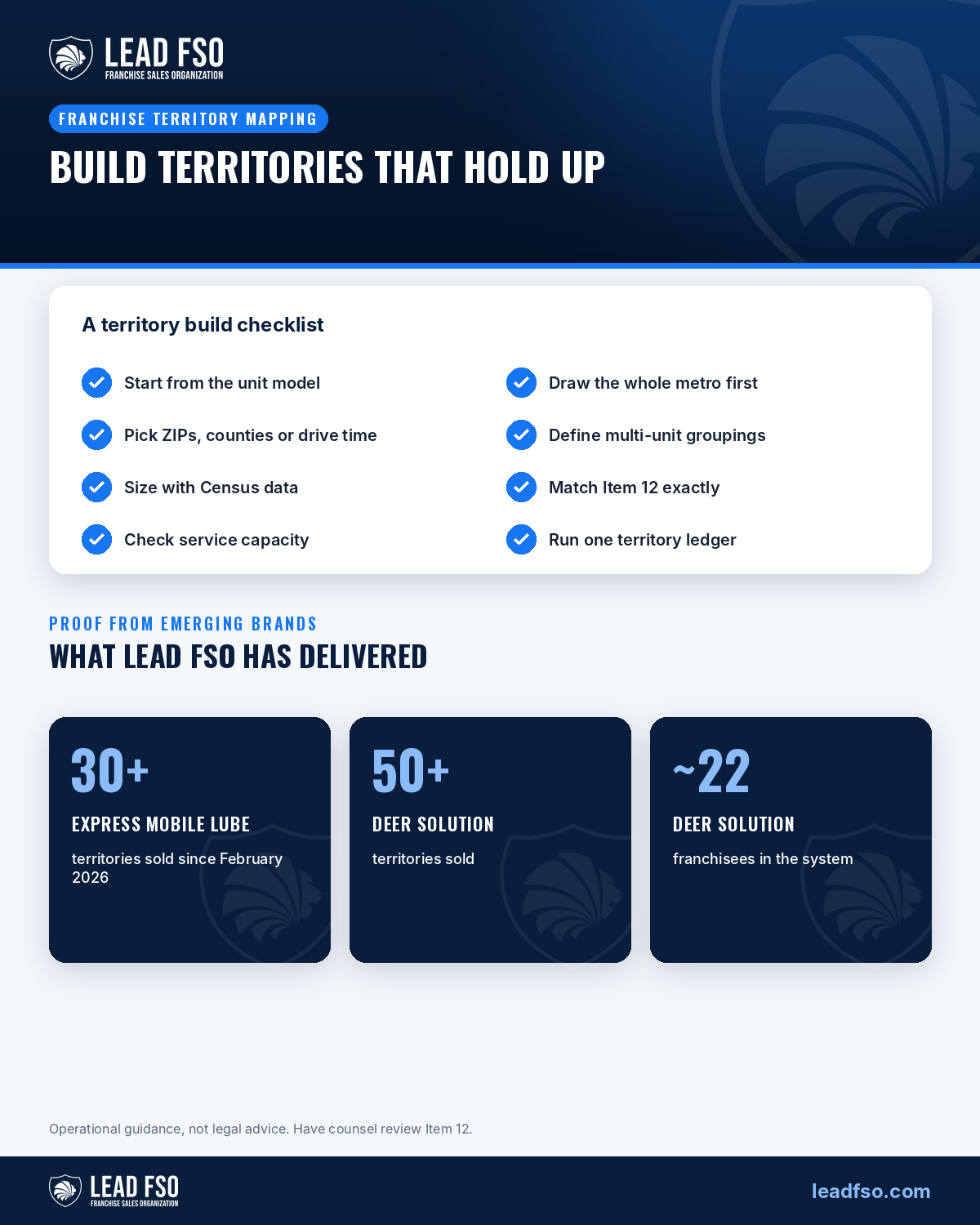
Start with the unit model. Work out what one location needs to succeed: households, businesses, vehicles, acres or whatever your customer base is. That number is the core of every territory.
Pick a building block. Most brands use ZIP codes, counties or drive-time zones. ZIP codes are easy to explain and to search. Drive-time zones fit service brands where travel time drives profit.
Use public data. U.S. Census Bureau data on households, income and businesses is free and lets you size territories consistently from market to market.
Size for service capacity. A mobile or home-service brand needs territories a crew can actually cover. Too large and service suffers; too small and the unit cannot grow.
Plan the whole market first. Draw every territory in a metro area before selling the first one, so the best area does not get sold alone and leave the rest of the market impossible to fill.
Decide how multi-unit deals work. If you sell area development agreements, define how territories are grouped and what development schedule applies before candidates ask.
Item 12 and the Rules That Shape Your Map
Your territory decisions have to match what your FDD says. Item 12 is the territory section, and it is where many candidates and their attorneys look first.
What Item 12 covers:
- Whether you grant a territory, and how it is defined.
- Whether the territory is exclusive and what you reserve the right to do inside it, such as other sales channels or national accounts.
- Any conditions a franchisee must meet to keep the territory, such as minimum sales or development schedules.
- Whether the franchisee can relocate or add outlets.
Non-exclusive territories need specific language. Under the FTC Franchise Rule, if you do not grant an exclusive territory, Item 12 must say so plainly, including that the franchisee may face competition from other franchisees, company-owned outlets or other channels or brands you control.
Keep sales materials consistent. Maps, territory packages and rep conversations must match Item 12. A rep who calls a territory “protected” when Item 12 says otherwise creates real legal risk. State registration and disclosure rules also vary, so have counsel review your territory materials along with the FDD.
How Franchise Territory Mapping Speeds Up the Sale
Candidates hesitate when they cannot picture what they are buying. A clear territory view removes that friction at each stage.
Early calls: A rep can show open territories in the candidate’s market during the first conversation instead of promising to check.
Between calls: A candidate can study the boundaries, demographics and open options with their spouse or advisor on their own schedule.
Discovery Day: Leadership can talk about a specific territory, not a general market, at Discovery Day.
Lender files: A defined territory with population data makes the business plan easier to put together for SBA or conventional lenders.
Urgency without pressure: When candidates can see which nearby territories are already sold or in contract, they understand the market is moving, without a rep having to push.
Territory Ledger Discipline
The best map in the world fails if two reps sell the same ZIP codes. Every franchisor needs one source of truth.
A good territory ledger tracks:
- Status for every territory: open, reserved, FDD out, in contract or sold.
- Who holds a reservation and when it expires.
- The boundary definition used in the franchise agreement, exactly as signed.
- Links to signed documents for each sold territory.
Set reservation rules. Decide how long a candidate can hold a territory, what it takes to hold one, and who can approve an extension. Write it down so reps do not make it up deal by deal.
Reconcile weekly. Review the ledger in a weekly development meeting so marketing stops advertising sold areas and reps know what is still available.
How Lead FSO Uses Territory Explorer and Hub
Lead FSO built its own platform for this, and it is one of the reasons our franchise development reps can move faster than a team working from spreadsheets.
Territory Explorer for candidates. Each brand gets a private, access-code Explorer where qualified candidates can see open territories, review figures drawn from the brand’s FDD, and build their own territory package.
Team Hub for your staff. Your team and ours share a Hub with the territory builder and ledger, the prospect pipeline, invitations and signed documents in one place.
Full-funnel support. We generate the leads, a dedicated rep works them with a weekly call to your team, and we close the deals. We take no royalty share and no equity.
Built for brands that are still small. Express Mobile Lube has sold more than 30 territories since starting with Lead FSO in February 2026, and Deer Solution has about 22 franchisees and more than 50 territories sold. Both began with one to three locations.
Frequently Asked Questions
What is franchise territory mapping?
Franchise territory mapping is the process of defining the geographic areas a franchisor sells, sizing them around the customers one location needs, and presenting them so candidates can see what is open and what they would own. It also covers tracking which territories are reserved and sold.
How big should a franchise territory be?
Size it around your unit economics, not a round number. Work out how many households, businesses or other customers one location needs to succeed, then build territories from ZIP codes, counties or drive-time zones that reach that number. Service brands also need to check that a crew can cover the area.
Does a franchise territory have to be exclusive?
No. But Item 12 of the FDD must describe the territory accurately, and under the FTC Franchise Rule a non-exclusive territory requires a clear statement that the franchisee may face competition from other franchisees, company outlets or other channels. Have franchise counsel review your Item 12 language.
How long should a candidate be able to reserve a territory?
There is no standard rule. Set a written policy for how long a reservation lasts, what a candidate must do to hold it and who can approve an extension, and track it in a single territory ledger so reps stay consistent.
What is the Lead FSO Territory Explorer?
It is Lead FSO’s own platform. Candidates get a private, access-code site where they can see open territories and build a territory package with figures drawn from the brand’s FDD, while the franchisor’s team uses a Hub for the territory ledger, pipeline and signed documents.
Need help? If territory questions are slowing your deals, talk to Lead FSO about the Territory Explorer and a dedicated franchise development rep.
Need Help?
If you’re considering enhancing your franchise sales strategy and driving quality leads, reach out to us through our Contact Us form. Let’s explore how we can support your franchise’s growth.








One Comment