

The candidate had the money, loved the concept and sailed through the first two calls. Then, on the FDD review call, he went quiet. “I need to think about it.” Two weeks later he stopped answering. Franchise sales objections like this are rarely about the brand. They are unanswered questions: about money, risk, territory or support. When the answer is clear, honest and compliant, the deal keeps moving. This guide covers the eight objections that stall franchise candidates most often and how to answer each one without overpromising.
- Most franchise sales objections are questions the candidate didn’t get a clear answer to earlier in the process.
- Earnings questions can only be answered with what is in your Item 19. Anything else risks an FTC Franchise Rule problem.
- Answer cost objections with Item 7 and real financing paths, not discounts.
- Let validation calls answer support and lifestyle objections; prep your franchisees so they can.
- Lead FSO’s dedicated reps handle objections every week, and our Territory Explorer answers territory and Item 19 questions before they are asked.
This article is operational sales guidance for franchisors, not legal advice. Franchise disclosure rules vary by state, so have your franchise counsel review your sales scripts and materials.
Why Franchise Sales Objections Happen
Buying a franchise is often the biggest financial decision a candidate will make. They are putting savings, a loan and sometimes their house behind it. Objections are how a careful buyer protects themselves. That’s good news: a candidate who raises objections is still engaged. The one who goes silent is the one you’ve lost.
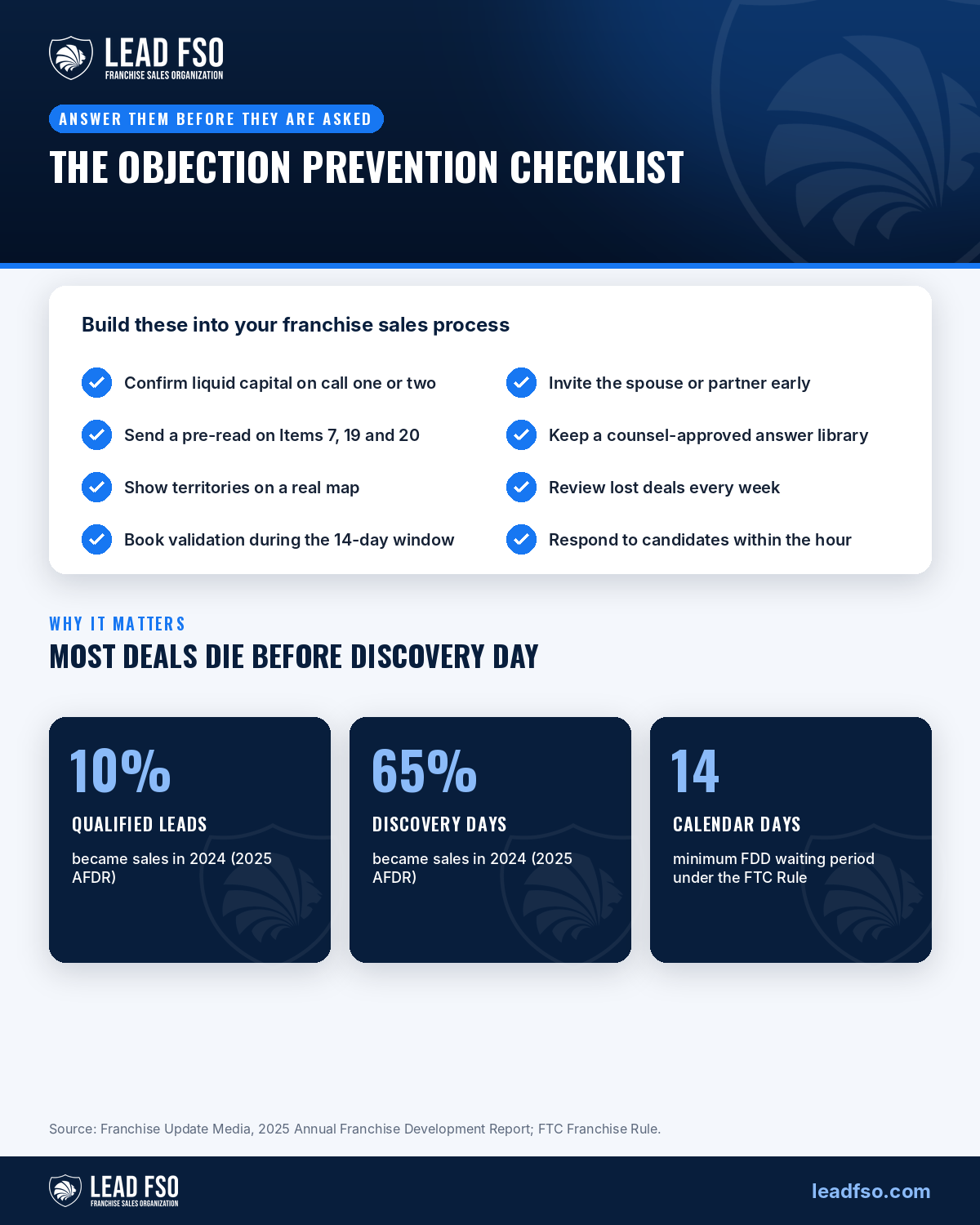
Franchise Update Media’s 2025 Annual Franchise Development Report found that about 65% of discovery days turned into sales in 2024, but only about 10% of qualified leads did. Most deals die before the candidate ever visits. That’s where unanswered franchise sales objections do the most damage.
Three rules for every objection
- Ask before you answer. “Tell me more about that” often shows the real worry behind the first one.
- Answer from the FDD. Point to the item that covers the question. It keeps you compliant and builds trust.
- Write it down. Log every objection in your CRM. If the same one shows up in a third of deals, fix it earlier in the process.
Money Objections: Cost, Financing and Earnings
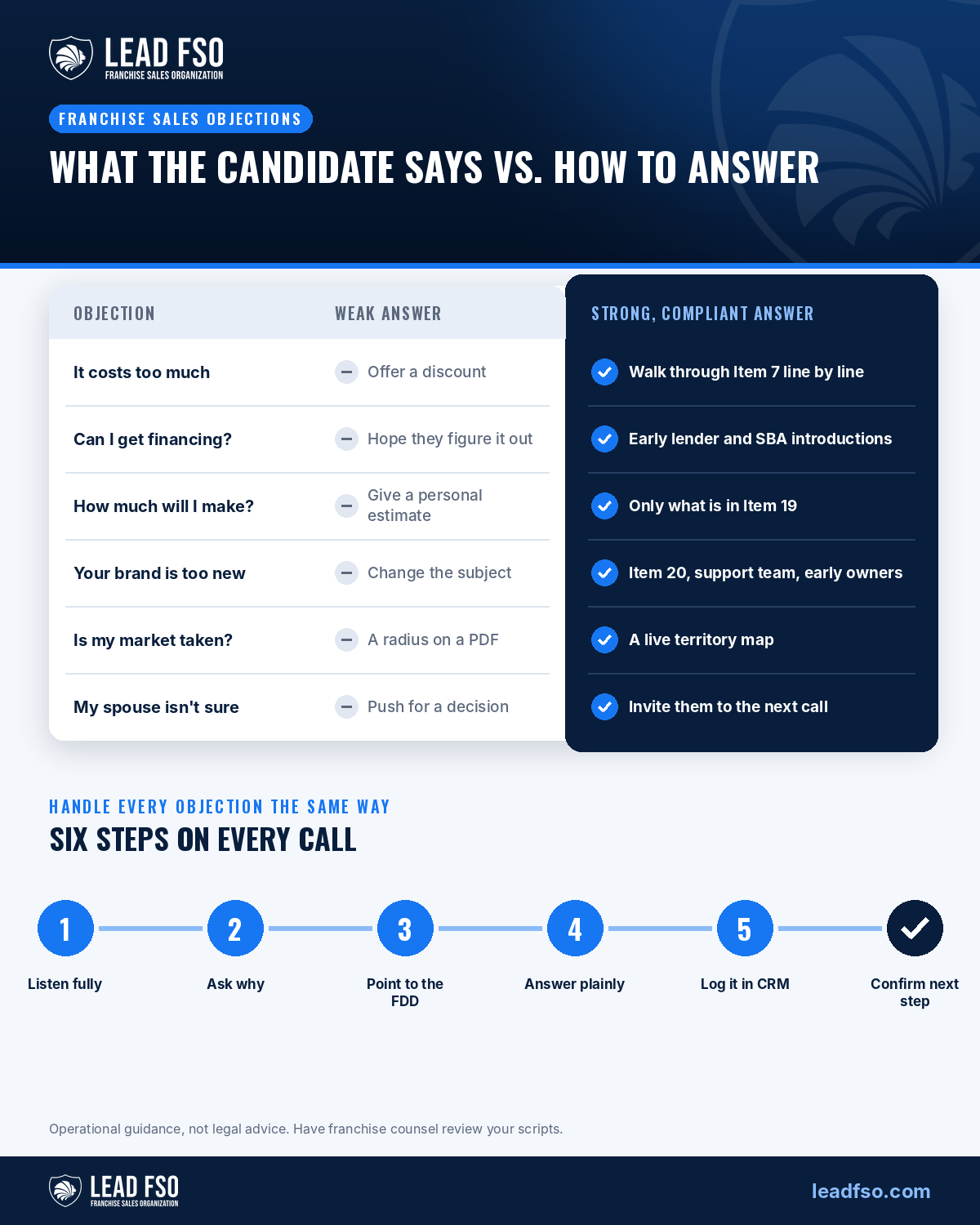
Objection 1: “It costs more than I expected.”
Walk through Item 7 line by line: franchise fee, build-out, equipment, opening inventory and working capital. Candidates often react to the top number without seeing what it buys. If the investment really is out of reach, say so. A candidate who can’t fund the business shouldn’t be sold one.
Objection 2: “I’m not sure I can get financing.”
Connect them early with lenders who know franchising, SBA lending options and, where it fits, retirement-fund rollover providers. Don’t give financial advice yourself. Our guide to franchise candidate financing support shows how to hand off to lenders without slowing the deal down.
Objection 3: “How much will I make?”
This is the one to get right. Under the FTC Franchise Rule, a franchisor can only share financial performance information that is in Item 19 of its FDD. Your reps can walk through the Item 19 numbers, explain what they include and suggest the candidate ask existing franchisees about their own results. They should never give a personal estimate, a “most of our owners make” figure or a spreadsheet that isn’t based on Item 19. If you don’t have an Item 19 yet, read how Item 19 helps you close deals and talk to your counsel.
Risk Objections: Brand, Market and Timing
Objection 4: “Your brand is too new.”
Don’t hide it. Show what’s behind the brand: how long the concept has run, how the company units perform, who is on the support team and how many franchisees are open (Item 20 shows the numbers). Offer validation calls with your earliest owners. Being an early franchisee also often means better territory choice.
Objection 5: “What if my market is already taken?”
Show a real map. Candidates want to see their territory’s boundaries, population and competition, not a radius on a PDF. Our article on franchise territory mapping covers how to package territories candidates can actually buy.
Objection 6: “Now isn’t the right time.”
Ask what would make it the right time. Sometimes it’s a job bonus, a house sale or a spouse who hasn’t been on a call yet. Build a plan around that date and keep them warm with useful contact, not pressure. Never invent urgency like a fake “last territory” claim. It’s misleading and it can come back on you.
Fit Objections: Support, Lifestyle and Family
Objection 7: “I’ve never run this kind of business.”
Explain the training program and opening support in detail, using Item 11 as the guide. Then let franchisees answer the real question. Validation calls are the most believable proof that your support works. Prep your owners so they can talk about the first 90 days honestly.
Objection 8: “My spouse isn’t sure.”
Invite the spouse or partner to the next call and to discovery day. Many deals stall because the person who wasn’t on the calls hears it second-hand. Give them the same information and the same chance to ask questions.
When the honest answer is “this isn’t for you”
Some objections show a real lack of fit: not enough capital, no interest in the day-to-day work, or expectations your Item 19 can’t support. Disqualify those candidates kindly and early. An unhappy franchisee costs far more than a lost sale. Our candidate scorecard helps catch these before the FDD goes out.
When Each Objection Shows Up in the Sales Process
Franchise sales objections tend to show up at predictable stages. Knowing where to expect each one lets your reps prepare instead of react.
| Stage | Objections you’ll hear | What to have ready |
|---|---|---|
| First call | Cost, timing | Investment range, capital requirements, next-step plan |
| FDD review | Earnings, fees, brand age | Items 5 to 7, Item 19 and Item 20 walk-through |
| Territory and financing | Market, funding | Territory map, lender introductions |
| Validation | Support, workload, experience | Prepped franchisees across performance levels |
| Discovery day and close | Spouse, timing, final cold feet | Partner invite, clear signing timeline |
Late objections are the most expensive. A candidate who raises cost for the first time at discovery day has already used your team’s time, your travel budget and weeks of the pipeline. If your lost-deal notes show the same late objection again and again, move the answer earlier.
Building an Objection Library Your Reps Will Actually Use
An objection library is a short, shared document with the approved answer to each common objection. It keeps reps consistent and keeps you compliant.
- Start from real calls. Pull the last 20 lost deals and list the reasons candidates gave. Those are your first entries.
- One page per objection. Write the objection, the question to ask back, the plain answer, the FDD item it points to and what not to say.
- Get counsel to review it. Anything about earnings, fees or territory rights should be checked by your franchise attorney before reps use it.
- Practice it. Role-play the top three objections in your weekly sales meeting. Reading a script is not the same as answering a nervous buyer.
- Update it every quarter. When your FDD changes, your answers change too.
Handled this way, franchise sales objections stop being surprises and become a checklist your team works through with every candidate.
How to Prevent Franchise Sales Objections Before They Start
The best way to handle franchise sales objections is to answer them before they’re asked.
- Put the money talk early. Confirm liquid capital and net worth on the first or second call.
- Send a short pre-read before the FDD review call that points to Items 7, 19 and 20.
- Book validation calls during the 14-day FDD waiting period, not after it.
- Build an objection library. Write approved, counsel-reviewed answers for your top objections so every rep says the same thing.
- Review lost deals weekly. The reasons candidates give for walking away show you where your process is weak. Our pipeline metrics guide shows how.
- Respond fast. A candidate who waits days for an answer fills the gap with doubts. See franchise lead response time.
How Lead FSO Handles Objections for Franchisors
At Lead FSO, objection handling is a daily job, not a script on a shelf.
- Dedicated, named reps work your candidates from first call to signed agreement, and you get a weekly call on every deal and every objection that came up.
- We close the deals. We don’t just pass leads to your team and hope. We generate our own leads and carry each candidate through to the agreement.
- Our Explorer + Hub platform answers the big questions early. Candidates get a private Territory Explorer with real Item 19 numbers, available territories and a build-your-own-package flow, so money and territory objections are handled before the FDD call.
- No royalty or equity cut. You keep 100%% of your company.
- We work with emerging brands. Express Mobile Lube has grown to 30+ territories since February 2026, and Deer Solution has about 22 franchisees and 50+ territories sold. Both started with one to three locations, when “your brand is too new” was the objection they heard most.
Frequently Asked Questions
What are the most common franchise sales objections?
The most common are cost, financing, expected earnings, a brand being too new, territory availability, timing, lack of experience and a hesitant spouse or partner. Most come down to a question the candidate didn’t get a clear answer to earlier.
How should a franchisor answer “How much will I make?”
Only with the financial performance information in Item 19 of the FDD. Reps can explain the Item 19 figures and suggest the candidate ask existing franchisees, but they should not give personal earnings estimates. Have franchise counsel review your approach.
How do you handle a candidate who says the franchise costs too much?
Walk through Item 7 line by line so they see what the investment covers, connect them with franchise lenders, and if they truly can’t fund it, disqualify them kindly rather than pushing the deal.
Can objections be prevented?
Many can. Talk about money early, send a pre-read before the FDD call, book validation calls during the 14-day waiting period and keep a counsel-approved answer library for your most common objections.
Does Lead FSO handle objections for franchisors?
Yes. Lead FSO’s dedicated reps work every candidate through to a signed agreement, report on objections in a weekly call and use the Territory Explorer to answer territory and Item 19 questions early.
Need Help?
If you’re considering enhancing your franchise sales strategy and driving quality leads, reach out to us through our Contact Us form. Let’s explore how we can support your franchise’s growth.