




Emerging franchise brands hear the same answer from most brokers and franchise sales organizations: call us back when you have twenty units open. The trouble is that a founder with one, two, or three locations is the one who needs franchise sales help the most. Without it, the brand sits at three locations while the FDD ages on a shelf. We built Lead FSO to take the brands other firms pass on, and this article explains how that works and what it has produced.
Key Takeaways
- Most brokers and FSOs avoid emerging franchise brands because early deals take more work and commission-only economics reward easy closes.
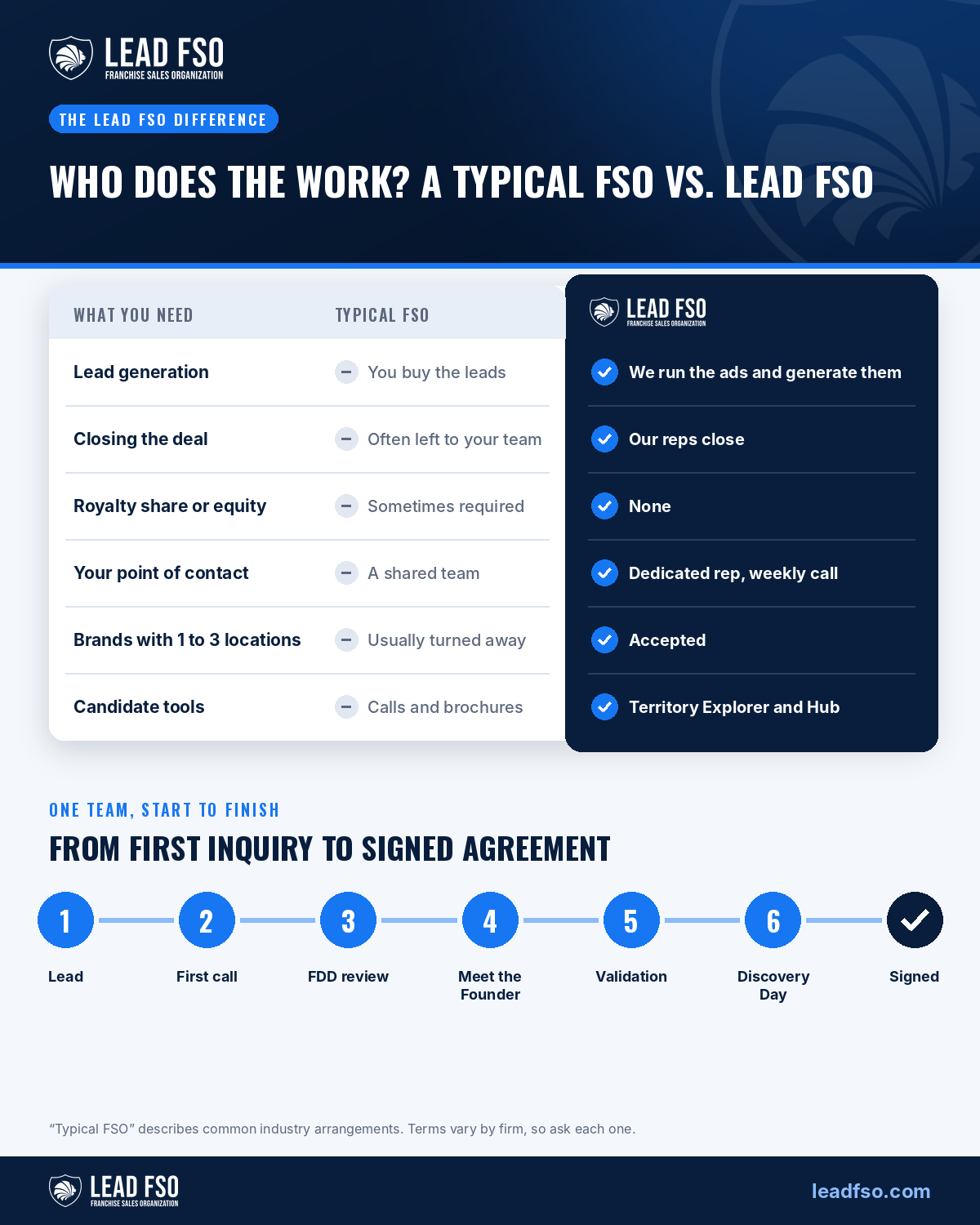
- The typical FSO works leads you supply and leaves the closing to you. Lead FSO generates its own leads and closes the deals.
- We take no royalty percentage and no equity. You keep your royalty stream and your company.
- Every brand gets a dedicated franchise development rep and a weekly call.
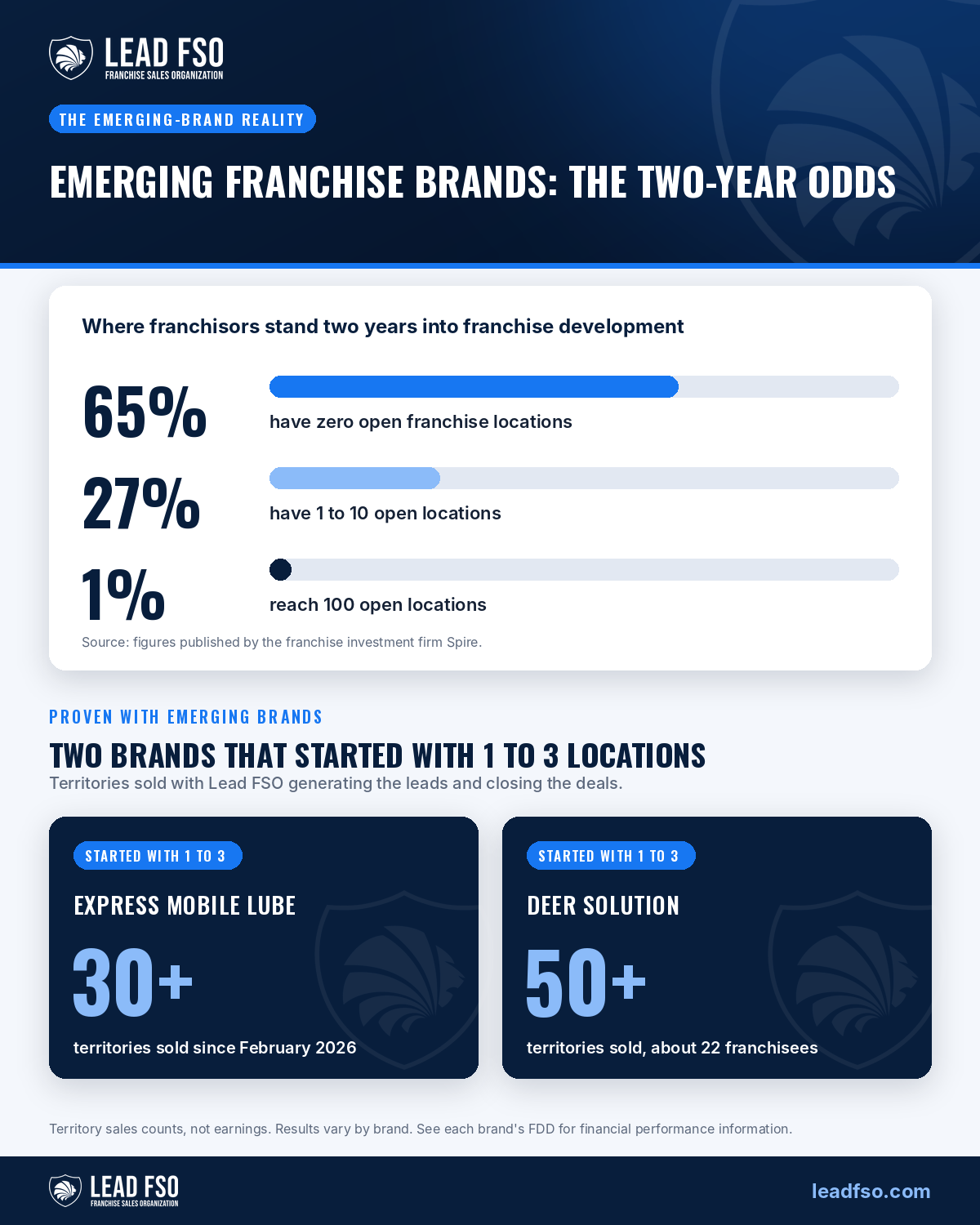
- Express Mobile Lube has sold more than 30 territories since starting with us in February 2026. Deer Solution has about 22 franchisees and more than 50 territories sold. Both began with one to three locations.
This article describes how Lead FSO works with franchisors. Territory sales at one brand do not predict results at another, and nothing here is a financial performance representation or legal advice. Have franchise counsel review your FSO agreement and your sales materials.
Why Most Brokers and FSOs Pass on Emerging Franchise Brands
The reasons are economic, not personal. A broker or commission-driven FSO earns when a deal closes, so the rational move is to spend time on brands that close fast.
Emerging franchise brands close more slowly for reasons a founder cannot fix overnight:
- Thin validation. A candidate wants to call owners. A brand with two locations has very few owners to call. Our guide to franchisee validation calls covers how to handle that honestly.
- Little name recognition. The candidate has not seen the brand in their town, so the sales conversation starts with the business model, not the logo.
- An untested sales process. There is often no CRM, no nurture sequence, and no Discovery Day agenda. Someone has to build them.
- A small budget. Large retainers and broker commissions are hard to carry before the first franchise fees arrive.
So the firms best placed to help often wait until the hard part is finished.
The Numbers Emerging Franchise Brands Are Up Against
Figures published by the franchise investment firm Spire describe where franchisors stand two years into their development effort:
- 65% have no open franchise locations.
- 27% have between one and ten.
- About 1% reach 100 open locations.
Spire also reports that only about 6% of franchises ever reach 100 units and that more than 300 franchisor brands fail each year. Capital is one cause. Sales execution is another: a good concept with no steady flow of qualified candidates, and nobody whose full-time job is to move them from inquiry to signed agreement.
How a Typical FSO Deal Is Structured
Before you compare firms, it helps to know the common arrangements. Our post on FSO contract terms goes through the clauses in detail. In short:
- Retainer plus commission. The most common model. The FSO markets the brand and manages leads for a monthly fee and earns a commission on each franchise sold.
- Leads worked, not generated. Many firms work the leads you buy from portals and brokers. Lead generation, and often the final close, stays with the franchisor.
- Royalty share or equity. Less common and more contested. The FSO takes a percentage of ongoing royalties or a stake in the franchisor.
The third arrangement deserves arithmetic. Franchise Performance Group has published this example: a 25-unit system averaging $500,000 per unit has $12.5 million in systemwide sales. A 1% royalty share to the FSO costs that franchisor $125,000 a year, every year, for work that ended when the agreements were signed.
7 Ways Lead FSO Works Differently for Emerging Franchise Brands
1. We take on brands with one to three locations
We have no unit minimum. We look for a current FDD, unit economics that hold up, and a founder who will take part in the sales process.
2. We generate our own leads
Our sister company, Lead PPC, has managed franchise development advertising for more than 500 franchise brands and more than $50 million in ad spend. Your candidates come from campaigns we build and run on Google and Meta, and the sales data feeds back into the ad targeting.
3. We close the deals
Our franchise development reps take candidates through the whole franchise sales process: first call, FDD review, Meet the Founder, validation, Discovery Day, and signing. You approve the franchisee. We do the selling.
4. No royalty percentage, no equity
We are paid for sales work. We do not take a cut of your royalties and we do not ask for ownership. The royalty stream you are building belongs to you.
5. A dedicated rep and a weekly call
Each brand has a named franchise development rep. You meet every week and review the same numbers we manage to: cost per lead, FDDs signed, Meet the Founder calls, Discovery Days, and cost per deal.
6. The Territory Explorer and Hub
We built our own platform, and we have not seen another FSO offer one like it. Each candidate receives a private Explorer, opened with an access code, where they can see which territories are open, study the market data behind each one, and build a territory package priced from the FDD fees. Your team works from a Hub that holds the territory ledger, the prospect pipeline, invitations, and signed documents. A candidate who has built their own package arrives at the next call with specific questions.
7. A sales process built for the long cycle
Emerging brands lose candidates in the gaps between steps. We run structured candidate nurture from the first inquiry through Discovery Day so that interest does not cool while the FDD waiting period runs.
Two Emerging Franchise Brands, Two Growth Stories
Express Mobile Lube. A mobile oil change and maintenance brand that came to us with one to three locations. Since franchise development began in February 2026, Express Mobile Lube has sold more than 30 territories. Its candidates use the Territory Explorer to choose territories and build packages before they sign.
Deer Solution. A deer-repellent service brand that also started with one to three locations. Deer Solution now has about 22 franchisees and has sold more than 50 territories.
These are territory sales counts, not statements about what any franchisee earns. Each brand’s own FDD is the only source for financial performance information.
Questions to Ask Any FSO Before You Sign
Whether you talk to us or to someone else, ask these:
- Do you generate the leads, or do I?
- Who closes the deal, your rep or my team?
- Do you take any share of royalties or any equity?
- Will I have one named rep, and how often will we talk?
- Which brands did you take on with fewer than five locations, and what happened?
- Who owns the lead data and the CRM records if we part ways?
The FTC’s Franchise Rule applies to anyone selling on your behalf, so also ask how the firm trains its reps on disclosure timing and financial performance representations.
Frequently Asked Questions
Why do most FSOs and brokers turn down emerging franchise brands?
Most are paid on commission, so they favor brands that already close quickly: systems with dozens of open units, a deep validation bench, and a known name. Emerging franchise brands take more work per deal, so many brokers and FSOs wait until someone else has done the early selling.
Should an emerging franchise brand give an FSO a royalty share or equity?
We do not ask for either. A royalty share is paid for the life of every franchise agreement, long after the sale is closed, and equity is permanent. Many franchise advisors tell franchisors to keep both off the table and pay for sales performance instead.
How many locations does a brand need before working with Lead FSO?
There is no unit minimum. We have taken on brands with one to three locations. What we look for is a current FDD, a business model that works at the unit level, and a founder who will show up for Meet the Founder calls and Discovery Days.
Who generates the leads, the franchisor or the FSO?
We do. Lead FSO runs franchise development advertising through our sister company, Lead PPC, and works those leads with our own franchise development reps. You are not asked to buy leads elsewhere and hand them to us.
How often will we hear from our franchise development rep?
Every week. Each brand has a dedicated franchise development rep and a standing weekly call that covers leads, FDDs signed, Meet the Founder calls, Discovery Days, and deals in progress.
What is the Territory Explorer and Hub?
It is our own platform. Candidates get a private, access-code Explorer where they can see open territories and build a territory package, with figures drawn from the brand’s FDD. Your team gets a Hub with the territory ledger, the prospect pipeline, and signed documents in one place.
Need Help?
If you’re considering enhancing your franchise sales strategy and driving quality leads, reach out to us through our Contact Us form. Let’s explore how we can support your franchise’s growth.








One Comment