

Paying in-house franchise development closers is where incentive design either protects brand standards—or quietly rewards marginal deals. Employers who copy a generic SaaS commission plan onto franchise sales often discover too late that “closed” meant signed, not fundable, openable, or operable.
Key Takeaways
- Build employer-side plans from role, cycle length, and quality gates—not from a single “industry average %.” Publish OTE, pay mix, earning event, and clawback rules in writing before the period starts.
- Common sales pay-mix patterns (illustrative, not franchise mandates): closer roles often lean toward balanced base/variable (for example around 50/50 or 60/40); SDR / development-rep roles often run more base-heavy (for example around 60/40 or 70/30). Your market, margins, and cycle should set the real mix.
- Pay on quality outcomes (executed agreement + cleared funds, or opened unit—define it) and split multi-unit / ADA credit deliberately so reps do not game unit count.
- SPIFs work when they are time-boxed, eligible-deal clear, and unable to override scorecard or Item 19 / advertising rules.
- Clawbacks belong on early unwind, nonpayment, or eligibility fraud—not on ops failures outside the rep’s control. State wage law may limit how you recover “earned” wages; have employment counsel review the plan.
- Separate SDR and closer metrics. Tying SDRs solely to closed revenue in a long franchise cycle usually creates a useless feedback loop.
Compensation structures interact with employment law, franchise disclosure, and brand compliance. This is employer-side design guidance for franchisors building in-house development teams—not legal, tax, or securities advice. Have employment counsel and franchise counsel review the plan you actually put in offer letters.
Start From Role, Cycle, and Quality—Not a Copied Percentage
A workable franchise development plan starts with who does the work, how long deals take, and what “good” means for your brand—then back into base, variable, and accelerators. Copying someone else’s commission rate without matching earning events is how misalignment sneaks in.
Define before math:
- Roles: SDR / appointment setter vs. closer / franchise development director vs. player-coach manager.
- Cycle: Months from inquiry to funded agreement (and to open, if you pay on openings).
- Quality gates: Scorecard pass, disclosure timing respected, no unapproved financial performance talk, territory rules followed.
- Earning event: When variable is earned vs. advanced (signature, funds cleared, training complete, unit open).
OTE (on-target earnings) is base plus target variable at 100% of quota. The commission rate falls out of OTE, pay mix, and quota—it is not a mystical franchise constant. Avoid publishing a public “typical franchise development commission is X%” unless you have a sourced benchmark you are willing to defend; ranges and qualitative design beat invented averages.
Base, Variable, and SPIFs for In-House Closers
Most in-house closer plans use a meaningful base (franchise cycles are long and compliance-heavy) plus variable tied to qualified closings, with optional short SPIFs for strategic pushes. Pure commission with no base can push quantity over fit; pure salary with no variable can stall urgency.
Design notes:
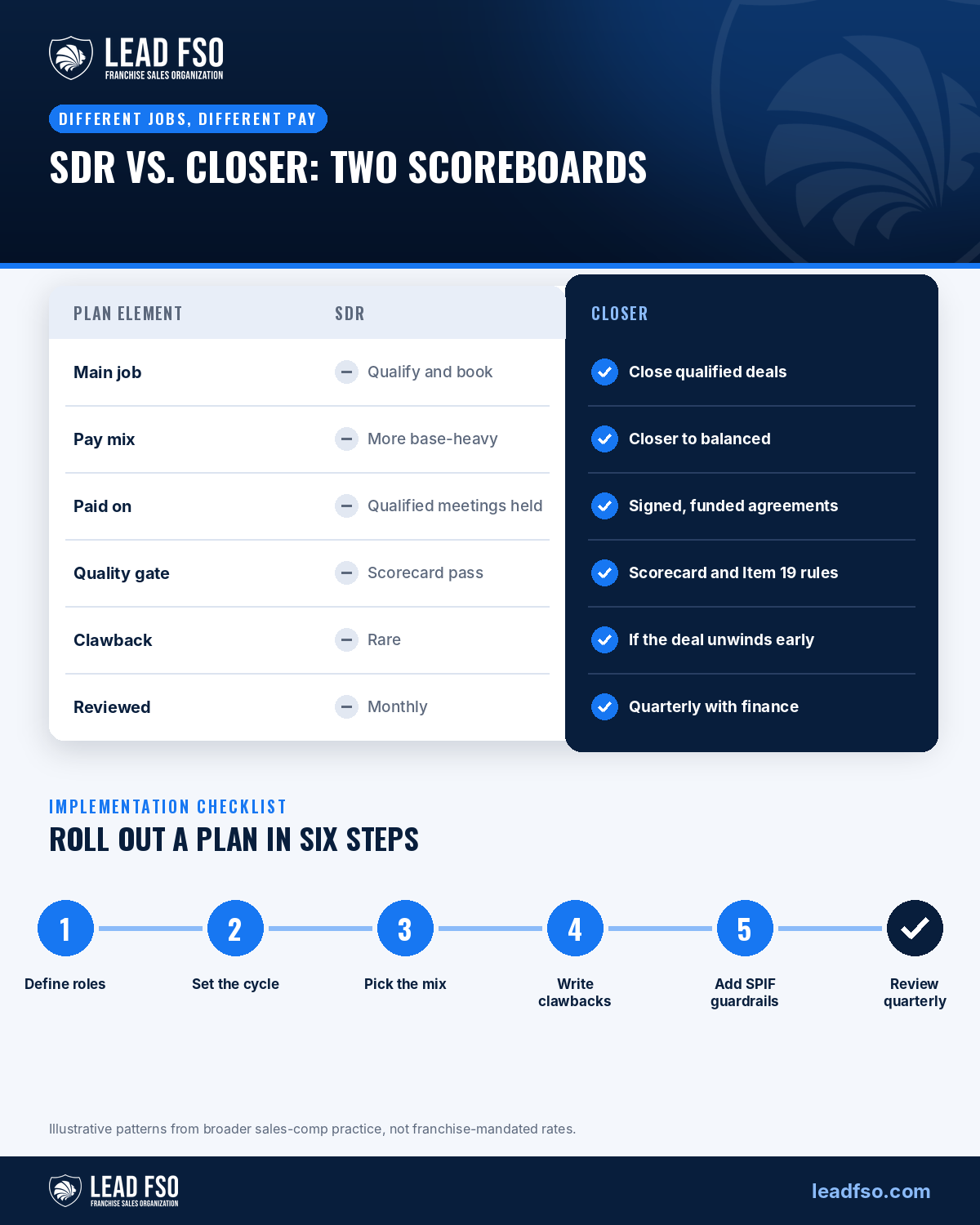
- Pay mix: Longer, consultative closes often justify more base than transactional sales. Illustrative patterns from broader sales-comp practice—not franchise-mandated rates—include balanced mixes near 50/50 or 60/40 base/variable for closers, and more base-heavy mixes for SDRs. Set yours with finance using deal contribution and capacity.
- Quota: Count deals your brand can actually onboard. Inflated quotas train reps to pressure weak candidates.
- Accelerators: Above-quota accelerators are fine if quality gates still apply to accelerated deals.
- SPIFs: Time-boxed bonuses for priority territories, veteran multi-unit targets, or seasonal pushes. Document start/end, eligible deals, payout trigger, and payment date. Undocumented SPIFs create legal and morale risk.
If you also use outsourced FSOs, keep in-house plans coherent with how you pay partners—see how retainer-plus-success structures aim to align focus without royalty/equity conflicts in broader FSO discussions—and avoid double-paying the same credit under two policies.
Multi-Unit and ADA Credit Splits
Multi-unit and area development agreements need explicit credit rules so reps neither under-invest in complex deals nor inflate unit counts for payout. Write the split before the first ADA conversation.
Common employer approaches (pick one and publish it):
- Primary agreement credit: One deal credit at signing for the ADA/multi-unit agreement, with staged variable as subsequent units execute or open.
- Weighted units: First unit at full credit; additional committed units at a defined fraction until a cap.
- Team split: Predetermined percentages when SDR, closer, and manager all touched the file—mirroring the clarity you need in ADA sales process ownership.
Never let SPIFs for “extra units” bypass capital, capacity, or culture gates on your candidate scorecard.
Clawbacks Without Poisoning the Culture
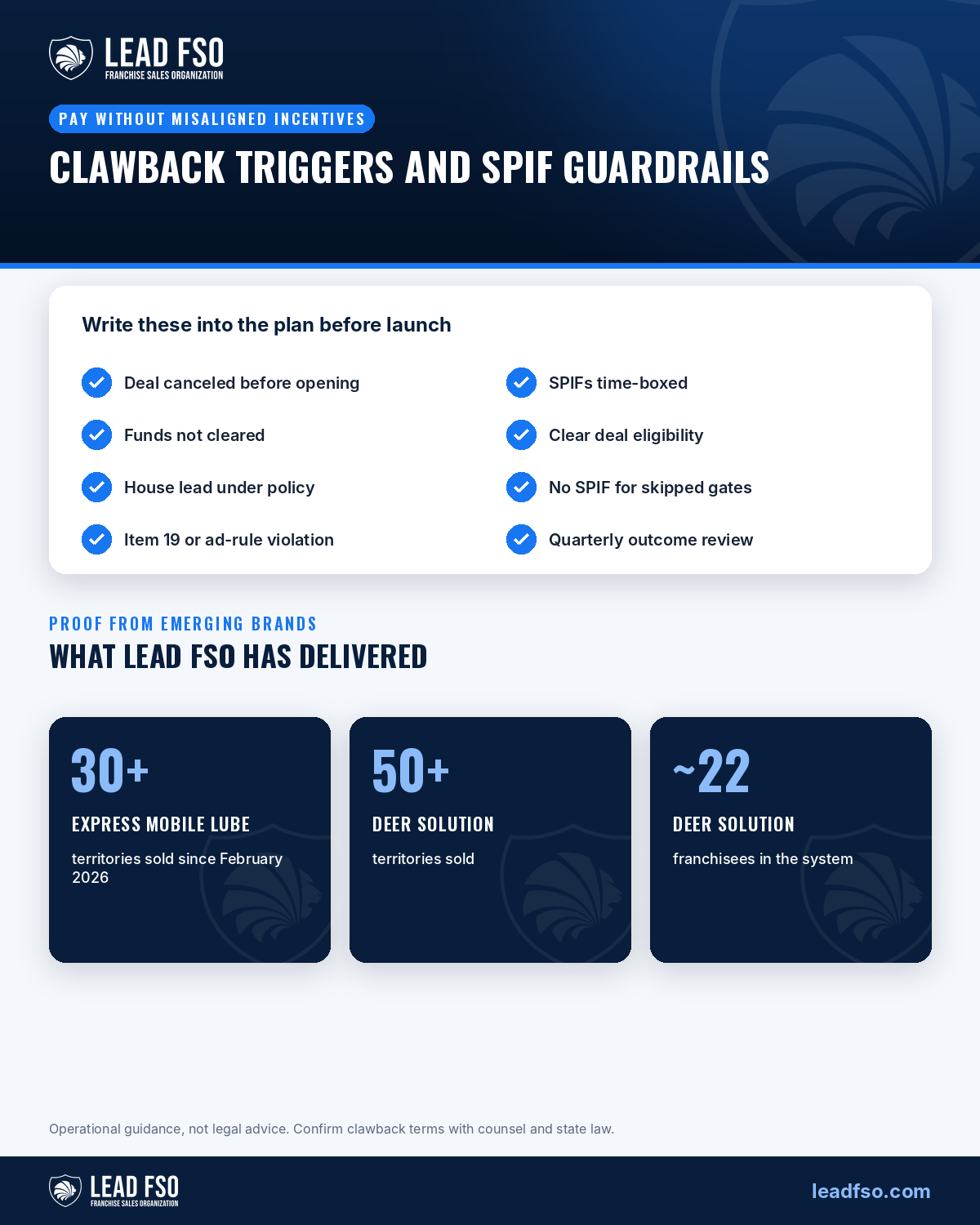
Clawbacks recover variable pay when the earning event unwinds—early cancellation, failure to fund, eligibility misrepresentation—not when operations later stumbles for reasons outside the rep’s control. Narrow, written clawbacks protect the brand; vague ones destroy trust.
- Window: Long enough to catch immediate unwind and nonpayment; short enough that later unit performance is an ops problem, not a comp surprise. Many sales plans use windows on the order of ~90 days for early churn/nonpay—confirm what fits your funding timeline and state law.
- Triggers: Deal canceled, funds not cleared, candidate was already a house lead under policy, or rep violated marketing/Item 19 rules on that deal.
- Method: Deduct from future variable or invoice per plan language employment counsel approves.
- Exceptions: Franchisor-caused delays, documented force majeure, or ops decisions that killed a funded deal.
Several states restrict recovering wages once “earned.” Define earning vs. advance carefully in the plan document and get counsel to review before you hire against it.
SDR vs. Closer: Different Scoreboards
SDRs and closers should not share one revenue-only scoreboard on a six-month franchise cycle. SDRs need near-term, quality-controlled activity metrics; closers need closing and compliance outcomes.
- SDR variable: Oftentied to qualified appointments held or stage advances that pass scorecard gates—not raw form fills.
- Closer variable: Tied to the earning event you defined (funded agreement, etc.).
- Handoff SLA: Written ownership when a lead moves from SDR to closer so credit disputes do not become candidate-facing drama.
Managers on override should be paid for team quality and process adherence, not only gross unit count.
Item 19, Brand Standards, and Comp Conflicts
Compensation must never pay reps for behavior that violates Item 19 rules, advertising claims policy, or disclosure timing. If a SPIF pays for speed, pair it with explicit disqualification for off-script financial performance representations or skipped waiting-period discipline.
- No variable credit on deals closed with unapproved earnings claims.
- No SPIF for “FDD out in 24 hours” if qualification gates were skipped.
- Audit a sample of closed files quarterly for scorecard and disclosure hygiene; claw back when the file fails eligibility rules everyone knew.
Align this with how you run the broader franchise sales process and any broker channel economics so one deal cannot generate conflicting payables and conflicting behaviors.
Implementation Checklist for Employers
Before the plan year (or the next hire):
- Write roles, OTE, pay mix, quota, earning event, accelerators, SPIFs, splits, and clawbacks in one document.
- Have employment counsel and franchise counsel review.
- Train reps on what does not pay as clearly as what does.
- Configure CRM fields so finance can calculate credit without Slack archaeology.
- Review plan outcomes quarterly: quality of closings, early unwind rate, and any Item 19 / advertising incidents tied to paid deals.
Frequently Asked Questions
What pay mix works for in-house franchise development closers?
There is no single mandated franchise mix. Longer, compliance-heavy cycles usually need a solid base plus variable tied to qualified closings. Broader sales-comp practice often places closers near balanced mixes (illustratively around 50/50 or 60/40) and SDRs more base-heavy—but your margins, quota math, and local labor market should set the real numbers with finance.
How should we pay on multi-unit or ADA deals?
Publish the rule before the deal: one credit for the ADA with staged payouts on later units, weighted credit per unit with a cap, or a fixed team split. Do not leave multi-unit credit to post-close negotiation, and never let unit-count SPIFs bypass qualification gates.
When do clawbacks make sense on franchise development deals?
When the earning event unwinds early—cancellation, nonpayment, eligibility fraud, or policy violations on that deal. Avoid clawing back for later operational failures outside the rep’s control. Put the window, triggers, and recovery method in writing and have employment counsel review enforceability in your states.
Should SDRs and closers share the same commission plan?
Usually no. SDRs need shorter-cycle metrics (qualified meetings or stage advances that pass gates). Closers need variable tied to the defined close/funding event. Shared revenue-only plans on long franchise cycles demotivate SDRs and muddy accountability.
Can SPIFs conflict with Item 19 or brand standards?
Yes—if they reward speed or volume without quality gates. Design SPIFs so deals with unapproved financial performance representations, disclosure violations, or skipped scorecard gates are ineligible. Audit paid deals against brand and disclosure rules.
Should we publish an “industry average” commission percentage to candidates for the sales job?
Be careful. Public “averages” are often unsourced and vary wildly by brand economics, fee size, and whether pay is on signature vs. opening. Prefer sharing your actual OTE range, pay mix, and earning event for the role you are hiring—and keep offer math in counsel-reviewed plan documents.
Need Help?
If you’re considering enhancing your franchise sales strategy and driving quality leads, reach out to us through our Contact Us form. Let’s explore how we can support your franchise’s growth.