




From FDD receipt to a signed franchise agreement is where otherwise-strong deals stall—waiting periods miscounted, attorneys starting late, lenders waiting on documents nobody queued, and silence treated as “they’re still reading.” Emerging and growing brands that close cleanly treat the post-disclosure window as an active project plan, not a quiet calendar hold.
Key Takeaways
- Under the FTC Franchise Rule, franchisors must furnish the current FDD at least 14 calendar days before the prospect signs a binding agreement with, or pays, the franchisor or an affiliate in connection with the proposed sale. The 14 days begin the day after delivery; signing/payment can occur on the 15th day after delivery.
- Item 23 is the receipt page: the prospect acknowledges delivery (issuance/effective date, seller info, exhibits). Keep signed receipts—franchisors should retain them (commonly for at least three years) to demonstrate compliance.
- A separate seven calendar-day review can apply when the franchisor unilaterally and materially changes the franchise (or related) agreement attached to the FDD; changes the prospect initiates generally do not trigger that extra wait. State franchise laws may add requirements—confirm with counsel.
- Sales activity during the wait is not “radio silence”: qualification follow-ups, validation prep, Discovery Day logistics, attorney/lender intros, and territory discussions can continue if they stay inside counsel-approved boundaries and do not pressure premature signing or payment.
- Run attorney review and lender packaging on parallel tracks with a week-by-week checklist so day 15 is operationally ready—not the day someone first emails the franchise agreement.
- Silence is a risk signal. Re-engage with a light, documented cadence; do not invent urgency that conflicts with the waiting period. On signature day, kick off ops (training dates, site path, CRM stage) immediately.
This article is operational guidance for franchise development teams, not legal advice. Waiting-period math, state registration issues, and agreement changes should be confirmed with franchise counsel for your brand and the prospect’s state.
The FTC 14-Calendar-Day Clock (and Item 23)
The federal waiting period is a 14-calendar-day review window after the prospect receives the current FDD—counted so they get a full 14 days before signing a binding agreement with, or paying, the franchisor or an affiliate for the proposed franchise sale. Delivery day does not count as day one; the earliest signing/payment day is the 15th day after delivery.
Example: FDD delivered Monday, January 1 → day one is January 2 → earliest signing/payment day is January 16 (assuming no intervening issues). Always calendar it explicitly in the CRM.
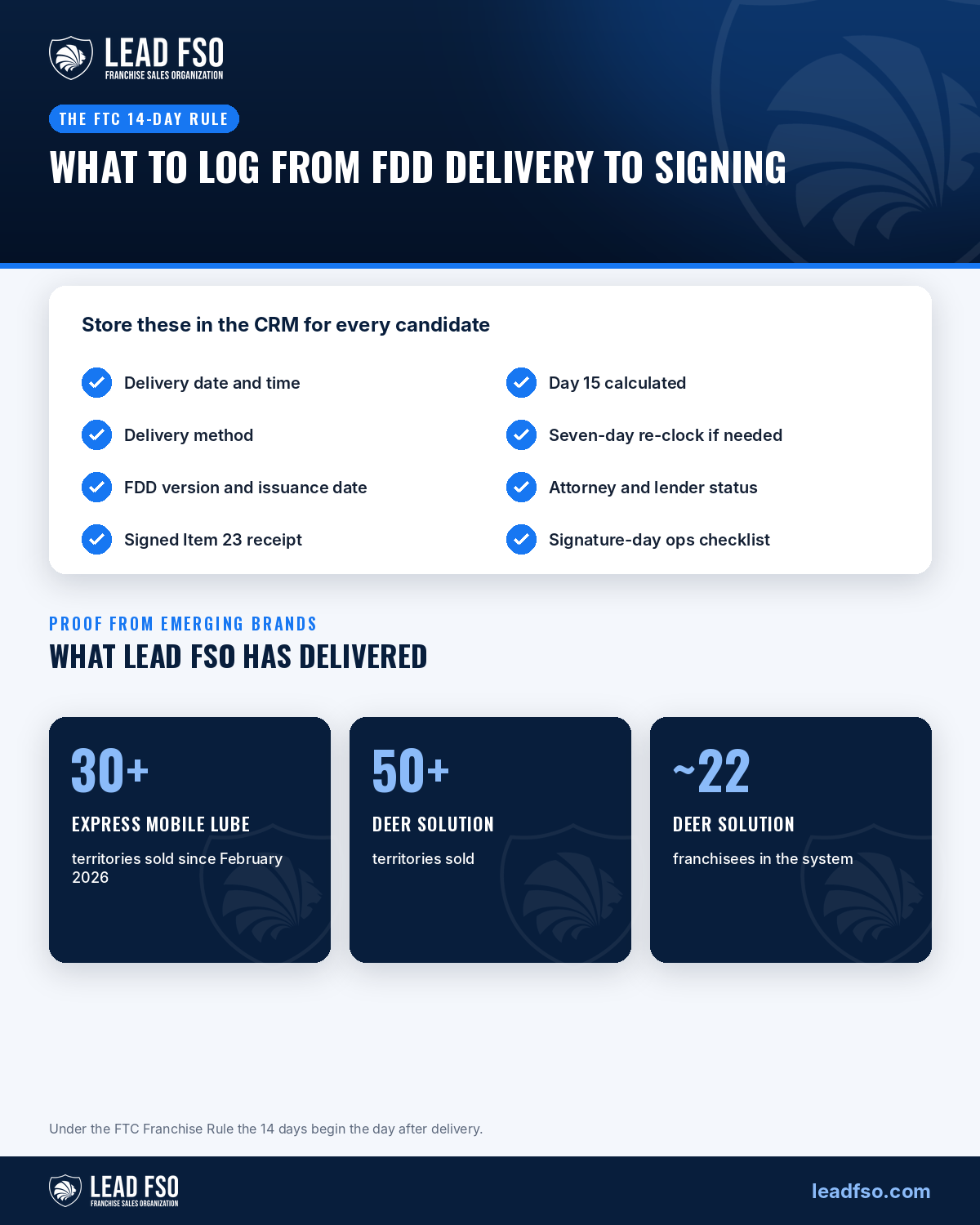
Item 23 is the receipt at the end of the FDD. It typically includes a required preamble about the 14-day timing, franchise seller information, the FDD issuance (or state effective) date, a list of exhibits, and a signature/date block for the prospective franchisee. Best practice is two copies: the prospect keeps one with the FDD; they sign and return the other. Your file is incomplete without that signed receipt.
Electronic delivery is allowed under the amended Rule when done correctly (including how “furnished” is documented). Whatever method you use, the CRM should store delivery timestamp, method, FDD version/issuance date, and the signed Item 23.
The Seven-Day Rule for Unilateral Material Agreement Changes
If the franchisor unilaterally and materially alters the basic franchise agreement (or related agreements) that were attached to the FDD already given to the prospect, the Rule requires furnishing the revised agreement at least seven calendar days before the prospect signs the revised agreement. Changes that arise from negotiations the prospective franchisee initiates generally do not trigger that extra seven-day period.
Operationally:
- Track whether any late edits were franchisor-driven vs. prospect-driven.
- If counsel flags a unilateral material change, re-clock the seven days and do not treat “we’re already past day 14” as automatic clearance.
- Fill-in-the-blank non-substantive fields (dates, names, addresses) are treated differently from new substantive terms (territory radius, economics, etc.)—let counsel classify edge cases.
Some registration states impose additional timing or delivery rules. Your close checklist should include a state-law check before you quote a signature date to a candidate.
What You Can Still Do During the Waiting Period
The waiting period restricts signing and payment timing—it is not a mandate to ignore the candidate. Strong teams keep momentum with activities that help the prospect evaluate the opportunity without shortcutting disclosure.
Usually productive during the wait (within counsel-approved scripts):
- Confirm questions on FDD items; route hard legal questions to franchise counsel—not to a rep improvising.
- Schedule and prepare franchisee validation calls and Discovery Day logistics.
- Introduce the prospect’s attorney and lender/packager; share only approved materials.
- Clarify territory availability process without promising a ZIP set you have not reserved under your internal rules.
- Complete scorecard gates you already use pre-disclosure where still open (capital verification follow-ups, timeline, capacity).
Avoid pressure tactics that undermine the purpose of the wait: “sign tomorrow or lose the territory” when tomorrow is still inside the federal clock, collecting fees early, or treating a non-binding “soft commit” as if it were an executable agreement. When in doubt, ask counsel for a short allowed-activity memo for your sales org.
Tie this window to the same discipline you use across the franchise sales process and your candidate scorecard.
Parallel Tracks: Attorney Review and Lender Packaging
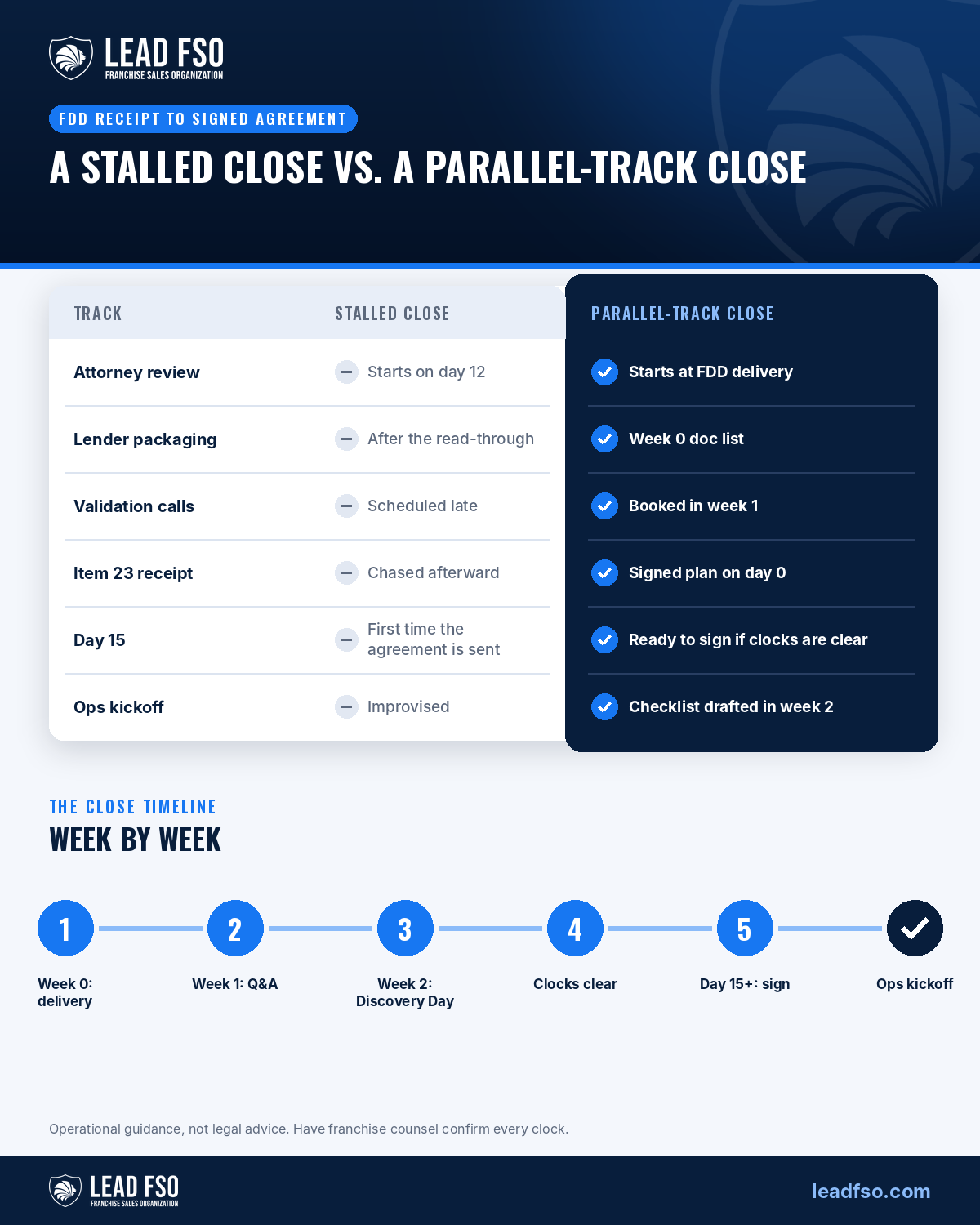
Attorney review and lender packaging should start as soon as the FDD is out—not after the prospect “finishes reading.” Deals stall when both tracks start on day 12.
- Attorney track: Prospect engages counsel; you provide the FDD, agreements, and a single point of contact for clarifications; log questions and answers.
- Lender track: Prospect (and packager) assemble SBA or conventional files using Item 7 / approved materials; you do not invent underwriting outcomes. Use a clean financing handoff.
- Internal track: Territory committee, ops readiness, training calendar holds, and any broker/FSO credit checks per your written rules.
Weekly standups (even 15 minutes) across development, finance, and ops prevent day-of-signature surprises.
Week-by-Week Close Checklist
Use a simple calendar from delivery day. Adjust for holidays and state-law extras, but keep the skeleton identical for every deal.
Week 0 (delivery day): Confirm FDD version, capture Item 23 signature plan, CRM timestamp, introduce attorney/lender resources, send validation prep packet, hold tentative Discovery Day or signing window past day 15.
Week 1: First Q&A pass, validation calls scheduled, lender doc list started, scorecard gaps closed, no pressure to sign.
Week 2: Second Q&A, Discovery Day or executive interview if earned, attorney issues list, financing status, draft signature-day ops checklist.
Day 15+ window: Only after clocks are clear—execute agreements, collect permitted funds per counsel, trigger ops kickoff. If a unilateral material agreement change appeared late, honor the seven-day rule before signing that revised agreement.
Silence Risk and Re-Engagement
Silence after FDD receipt often means confusion, competing brands, financing fear, or attorney delay—not “they’re carefully reading every exhibit.” Treat multi-day radio silence as a pipeline risk.
- Cadence: value-add check-ins (FAQ answers, validation scheduling help), not daily pressure texts.
- Ask directly what would make the next step easier—counsel intro, lender packager, another franchisee call.
- Document every touch. If the deal dies, your file still shows a responsible process.
Do not manufacture false scarcity that conflicts with waiting-period ethics. Real scarcity (territory under active decision with another candidate) should be stated factually and consistently with how you actually award territory.
Day-of-Signature Ops Kickoff
Signature day should start the operating relationship, not end the sales process in a dead stop. Before anyone leaves the table (or ends the DocuSign session), hand off:
- Training dates and portal access owners
- Site / real estate next steps (if applicable)
- CRM stage change to “closed/won” with document vault links
- Finance confirmation of funds and any rescission or cooling-off nuances counsel flagged for that state
- Intro to the ops or onboarding owner who speaks next
Brands that win post-signature momentum treat onboarding like a scheduled machine—the same seriousness they give Discovery Day agendas.
Frequently Asked Questions
How long is the FTC waiting period after FDD receipt?
At least 14 calendar days before the prospective franchisee signs a binding agreement with, or makes a payment to, the franchisor or an affiliate in connection with the proposed franchise sale. The 14 days begin the day after delivery, so signing or payment can occur on the fifteenth day after delivery—subject to any extra clocks (such as the seven-day rule for certain unilateral agreement changes) and state law.
What is Item 23 in the FDD?
Item 23 is the receipt. It documents that the prospect received the FDD, includes required seller and date information, lists exhibits, and provides a signature block. Franchisors typically use two copies and should retain signed receipts to show compliance.
Can we keep selling and coaching the candidate during the 14 days?
You can usually continue educational and process activities—Q&A, validation, Discovery Day planning, attorney/lender intros—while avoiding pressure to sign or pay early. Stay inside counsel-approved boundaries; the waiting period is about timing of binding commitments and payments, not a ban on communication.
When does the extra seven-calendar-day review apply?
When the franchisor unilaterally and materially changes the franchise agreement or related agreements attached to the FDD already delivered. Prospect-initiated negotiated changes generally do not trigger that extra seven days. Ask counsel to classify borderline edits before you lock a signature date.
How should attorney and lender work run in parallel?
Start both soon after FDD delivery: counsel reviews agreements while the prospect and lender/packager assemble financing files from approved materials. Weekly internal check-ins keep territory, ops, and document status aligned so day 15 is executable.
What if the candidate goes quiet after receiving the FDD?
Treat silence as a risk. Re-engage with helpful, documented touches—answer FAQs, offer validation or lender intros—without false urgency that conflicts with the waiting period. Ask what blocker they are facing and solve that blocker.
What should happen on the day the agreement is signed?
Kick off operations immediately: training schedule, site path, CRM stage and document vault, finance confirmation, and a named onboarding owner. Signature without an ops handoff is how “closed” deals feel abandoned.
Need Help?
If you’re considering enhancing your franchise sales strategy and driving quality leads, reach out to us through our Contact Us form. Let’s explore how we can support your franchise’s growth.








One Comment