

A candidate who has already sat through two calls and a webinar asks the question every franchise sales rep hears: “So what does a location like this actually make?” One rep answers with a number from memory. Another says “I can’t talk about that” and moves on. Either way, the deal gets harder to close. Franchise Item 19 is where that answer belongs. A well-built financial performance representation turns the most important question in franchise sales into a document you can walk a candidate through, line by line, without breaking the FTC Franchise Rule. This guide covers what Item 19 allows, what other franchisors now disclose, and how to use it to close deals.
Key Takeaways
- Franchise Item 19 is the only place in the FDD where you can give a candidate financial performance numbers, and your reps must stay inside it.
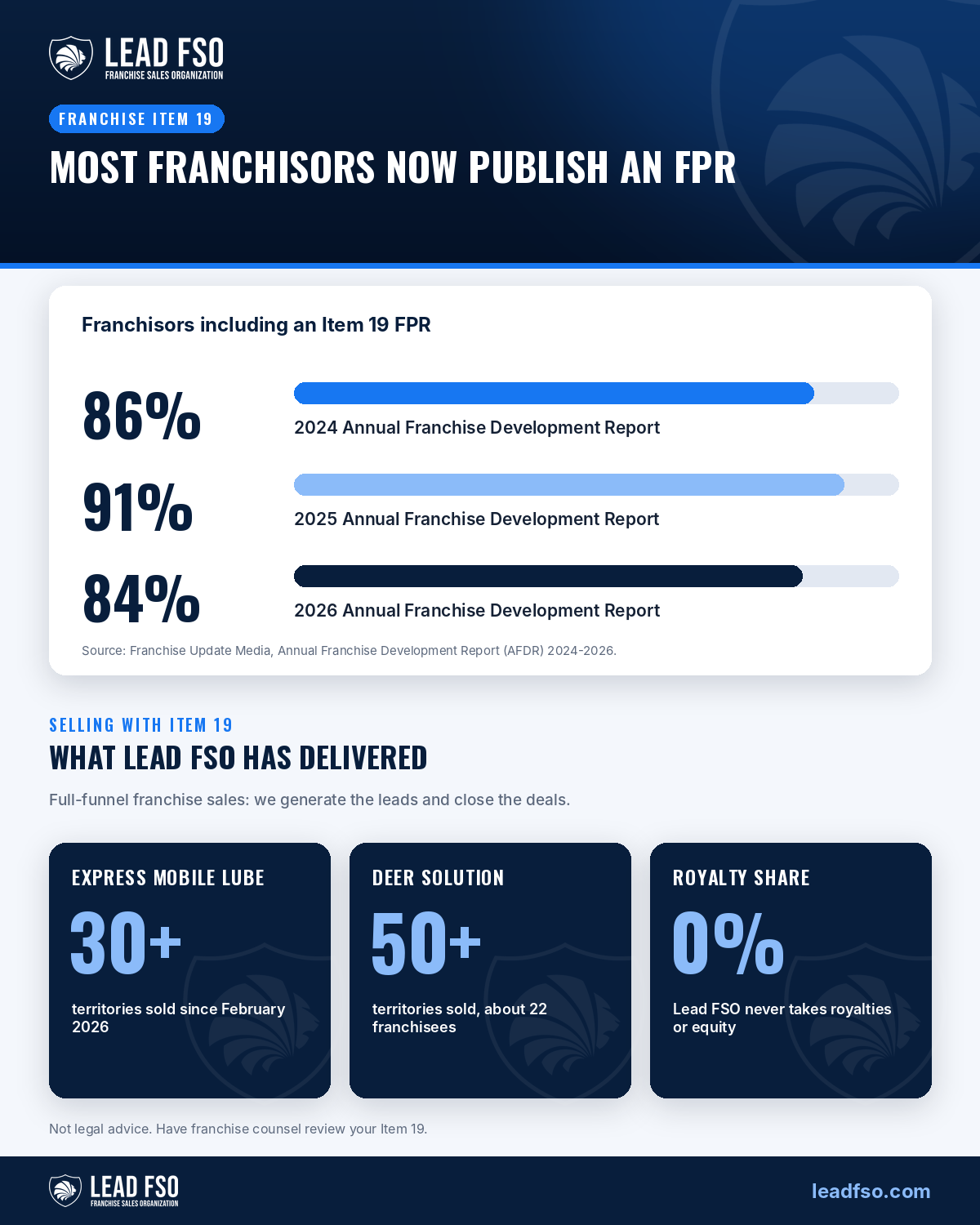
- Most franchisors now include one: 84% of franchisors in the 2026 Annual Franchise Development Report did, after 91% in 2025.
- Almost every Item 19 shows revenue; fewer show expenses, profit or a full P&L, so adding cost data can set your brand apart.
- Reps close faster when they teach candidates to read Item 19 and then send them to validation calls to test it.
- Lead FSO’s Territory Explorer shows candidates figures taken from your own Item 19, so every rep tells the same story.
This article covers franchise sales operations. It is not legal advice. What goes into Item 19, how it is substantiated and how state examiners review it are questions for your franchise counsel.
What Franchise Item 19 Is and What It Allows
Item 19 is the section of the Franchise Disclosure Document (FDD) set out in the FTC Franchise Rule (16 CFR 436.5(s)). It is where a franchisor may make a financial performance representation, or FPR: any statement, oral or written, that gives a candidate a specific level or range of sales, income, costs or profit, or lets them work one out.
The rules that matter most in sales:
- It is optional. A franchisor does not have to include an FPR. If it doesn’t, Item 19 must carry the required statement that the franchisor makes no financial performance representations.
- It needs a reasonable basis. Any FPR must have a reasonable basis and written substantiation at the time it is made, and the FDD must say which outlets the figures cover and what share of them hit the stated results.
- Nothing outside Item 19. If a number is not in Item 19, your reps, brokers and ads cannot give it. That includes “most of our owners do about…” on a call.
- One narrow exception. When a candidate is buying a specific existing outlet, the franchisor may share that outlet’s actual operating results.
State regulators add their own layer. NASAA’s Commentary on Financial Performance Representations, adopted in 2017, guides how examiners in registration states read Item 19, including how averages, medians and subsets are presented.
How Many Franchisors Include an Item 19 Today
Including an FPR has become the norm. Franchise Update Media’s Annual Franchise Development Report (AFDR), a survey of franchisors and development executives, tracks it each year:
| AFDR year | Franchisors including an FPR in Item 19 |
|---|---|
| 2024 | 86% |
| 2025 | 91% |
| 2026 | 84% |
In the 2026 report, every brand with more than 100 units included an FPR, as did 100% of retail food and retail non-food respondents. That has a direct sales consequence for emerging brands: a candidate comparing your FDD with two larger brands will notice an empty Item 19. If you are still early, an honest FPR built on a small number of outlets, clearly labeled, usually beats silence. Your counsel will tell you what you can support.
What Goes Into a Strong Item 19
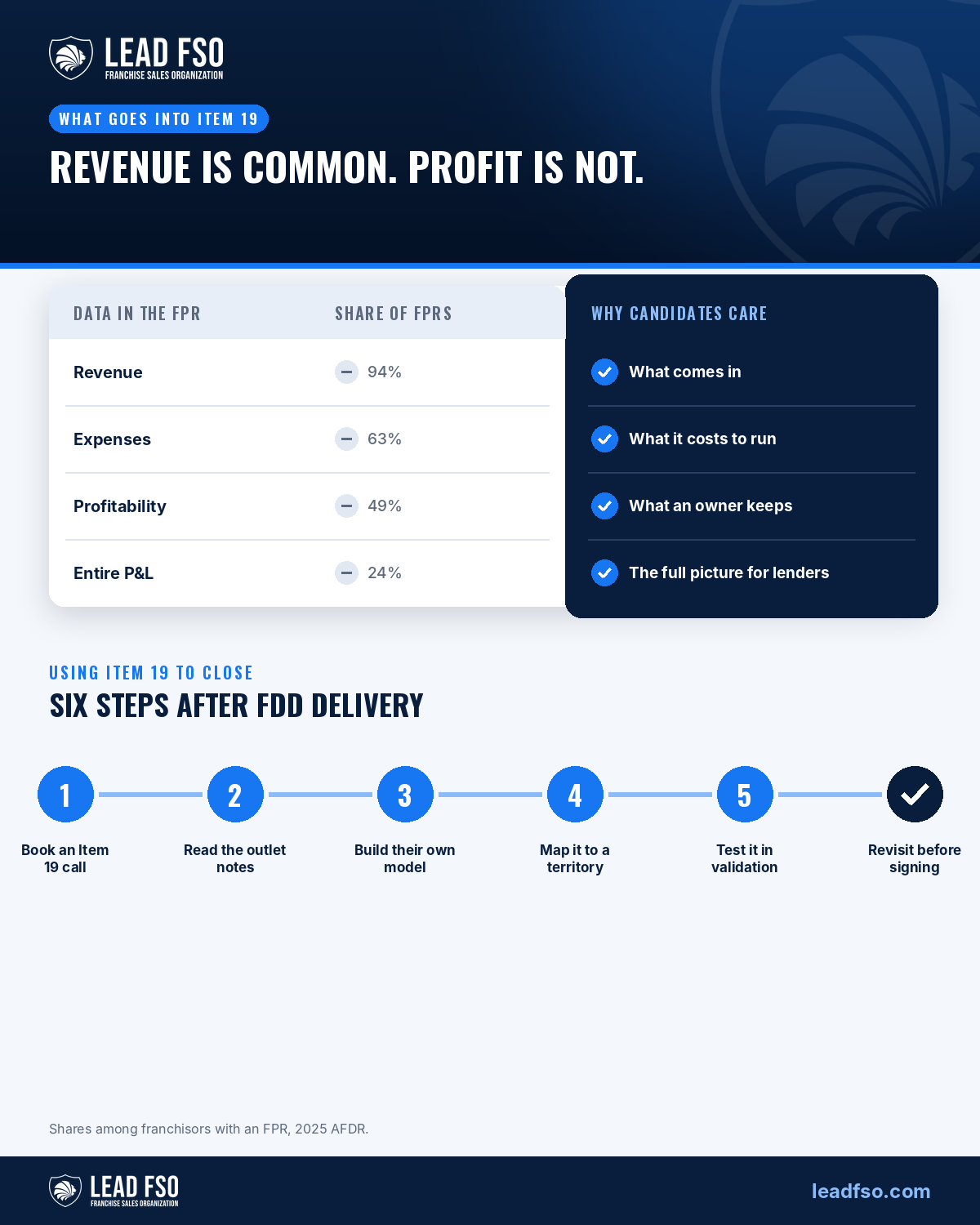
Among franchisors that include an FPR in their franchise Item 19, the 2025 AFDR found that 94% show revenue, 63% show expenses, 49% show profitability and only 24% show an entire P&L. Revenue alone tells a candidate what comes in, not what they keep, so the brands that disclose costs give buyers and their lenders more to work with.
Choices to make with counsel:
- Which outlets. All franchised outlets, a defined group (for example, open at least 12 months), or company-owned outlets shown separately. Every exclusion must be explained.
- Which measure. Averages are easy to read; medians and quartiles show the spread and are harder to misread. Many brands show both.
- Which costs. Cost of goods, labor, occupancy and royalty and marketing fees are what candidates and SBA lenders ask about first.
- How many hit it. State how many outlets reached or beat each figure. Candidates trust a number more when they can see the range around it.
Using Franchise Item 19 to Close Deals
A good franchise Item 19 does nothing if your reps avoid it. The franchise sales teams that close well treat it as a teaching document.
Walk it through, don’t summarize it. After the candidate signs the FDD receipt, book a call just for franchise Item 19. Open the document together, read the notes on which outlets are included, and show where their own plan fits. Reps should read from the page, not paraphrase it.
Build the candidate’s own model. Give candidates a blank worksheet with your Item 7 investment range and Item 19 figures, and have them fill in their local rent, wages and loan terms. When a buyer builds the numbers themselves, they defend them to their spouse and their lender.
Send them to validation with questions. Item 19 tells candidates what the system reports; franchisee validation calls let them test it. Give them a short list of questions to ask owners about ramp-up time, labor and the first year.
Tie it to the territory. Candidates think in places, not averages. Pair Item 19 with clear franchise territory mapping so they can see which open market they would run and what the outlets in similar markets reported.
Item 19 Mistakes That Stall Deals
- Off-script numbers. A rep who says “our top owners clear six figures” without that figure in Item 19 has made an FPR outside the FDD. It is a legal risk and it destroys trust when the candidate can’t find the number.
- Stale data. An Item 19 built on figures that are a year or more out of date invites hard questions at discovery day. Update it with each annual renewal.
- Hiding the spread. Showing only the top quartile, or averages without counts, makes candidates suspicious, and examiners in registration states will push back.
- Brokers off-message. Brokers and outside sellers are bound by the same rules. Give them the same Item 19 talking points your in-house reps use.
- Silence at the decision. Candidates make their decision in the window between the FDD and the signed agreement. If no one revisits Item 19 then, buyers fill the gap with guesses. Our FDD receipt to signed agreement timeline shows where that call fits.
How Lead FSO Uses Item 19 in the Sales Process
Lead FSO is a full-funnel franchise sales organization. We generate our own leads and our dedicated franchise development reps close the deals, with a weekly call so you always know where every candidate stands. We do not take a royalty share or equity, so we only win when you sell franchises that work.
Franchise Item 19 sits at the center of how we sell. Our Territory Explorer gives each qualified candidate a private, access-code site where they see open territories and build a territory package using figures from your brand’s own Item 19, so every candidate gets the same accurate numbers. Your team sees the same pipeline and signed documents in the Team Hub.
That process has worked for brands that started small. Express Mobile Lube has sold 30+ territories since starting with Lead FSO in February 2026, and Deer Solution has grown to about 22 franchisees and 50+ territories sold. Both began with one to three locations. If you are an emerging franchise brand, we take on brands at that stage.
Frequently Asked Questions
What is franchise Item 19?
Item 19 is the section of the Franchise Disclosure Document where a franchisor may make a financial performance representation, such as average sales, costs or profit of its outlets. It is optional, but if a franchisor gives any financial performance numbers to candidates, they must be in Item 19 and have a reasonable basis.
Is an Item 19 financial performance representation required?
No. The FTC Franchise Rule does not require an FPR. A franchisor that leaves it out must say in Item 19 that it makes no financial performance representations, and its sales team cannot give candidates numbers outside the FDD. In the 2026 AFDR, 84% of franchisors included one.
Can a franchise sales rep share numbers that are not in Item 19?
Generally no. Any statement that gives a candidate a specific level or range of sales, income or profit is an FPR and must be in Item 19. The main exception is sharing the actual results of a specific existing outlet that the candidate is buying.
What should a franchisor include in Item 19?
Most include revenue, and many add expenses and profit. In the 2025 AFDR, 94% of FPRs showed revenue, 63% expenses, 49% profitability and 24% a full P&L. Work with counsel on which outlets to include, which measures to show and how many outlets reached each figure.
How does Lead FSO use Item 19 to help close deals?
Lead FSO’s reps walk candidates through Item 19 after FDD delivery and use the Territory Explorer, which shows figures from the brand’s own Item 19 alongside open territories, so every candidate gets the same accurate numbers.
Need help? If candidates keep stalling at the money question, talk to Lead FSO about a sales process built around your Item 19 and a dedicated franchise development rep.
Need Help?
If you’re considering enhancing your franchise sales strategy and driving quality leads, reach out to us through our Contact Us form. Let’s explore how we can support your franchise’s growth.