

Your CFO asks a simple question at the budget meeting: what did it cost us to sign each franchisee last year? The marketing team has a cost per lead. The broker invoices are in a different folder. Salaries, travel and discovery day costs sit somewhere else again. Nobody can answer with one number. The cost per franchise sale is the number that ties all of it together, and most franchisors don’t track it. This guide covers the real industry benchmarks, what goes into the number, why it climbs and how to bring it down without starving your pipeline.
- Cost per franchise sale is your total development spend for a period divided by the agreements you signed in that period.
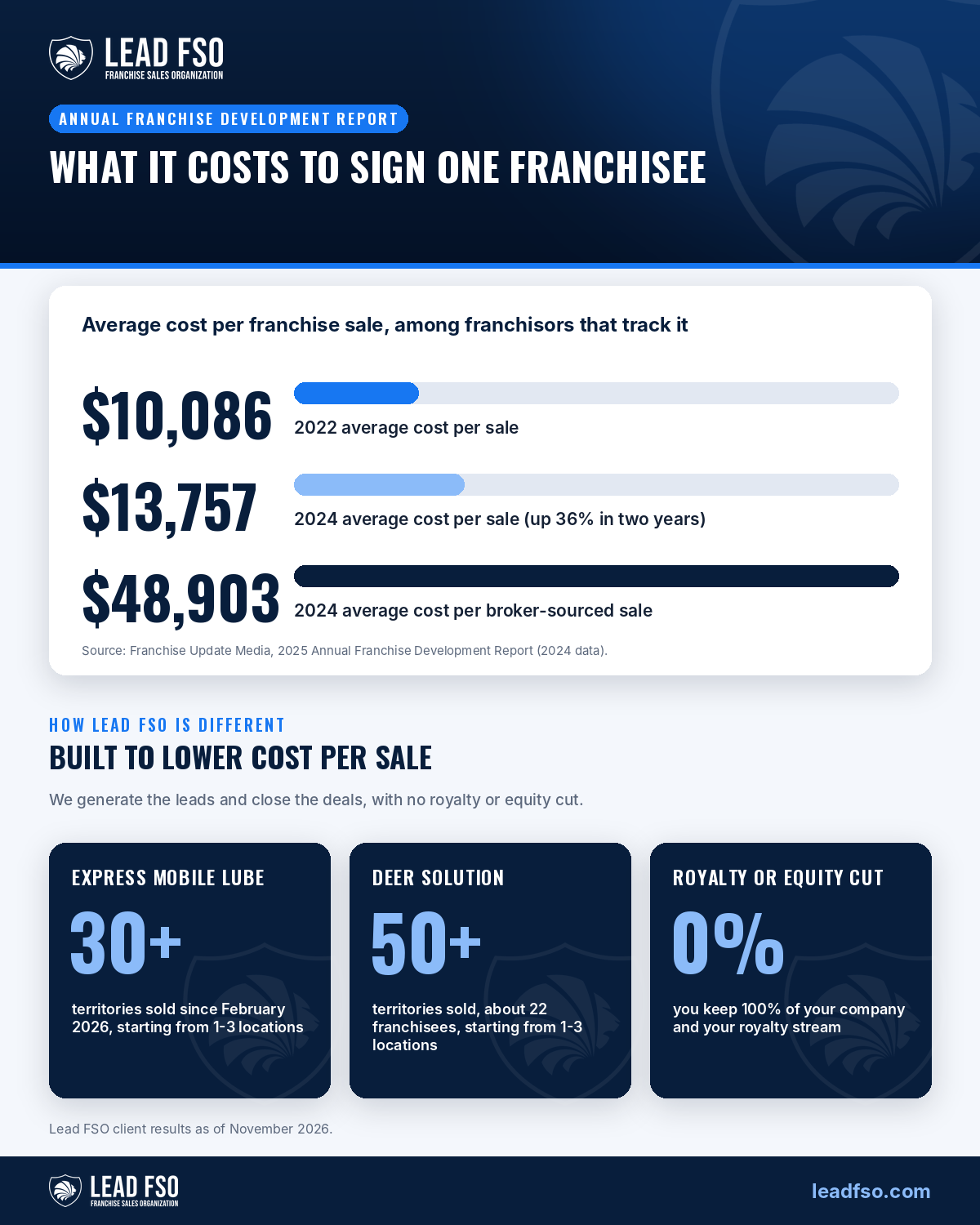
- Franchisors in the Annual Franchise Development Report averaged $13,757 per sale in 2024, up from $10,086 in 2022, and fewer than half even track it.
- Broker-sourced sales averaged $48,903 per sale in 2024, against $18,983 for non-broker sales at the brands that beat their sales goals.
- Small systems pay more per lead, so conversion at every stage matters more for emerging brands than for big ones.
- Lead FSO generates its own leads and closes the deals for a set fee, with no royalty or equity cut, so your cost per sale stays predictable.
What Is Cost Per Franchise Sale?
The cost per franchise sale is what you spend, in total, to get one signed franchise agreement. The simple formula is:
Cost per franchise sale = total franchise development spend in a period ÷ franchise agreements signed in that period
It is different from cost per lead. A cheap lead that never signs costs you money and team time. A $400 lead from a source that converts well can be the cheapest sale you make all year. Cost per lead tells you what you paid to get a name. Cost per sale tells you what you paid to get a franchisee.
What to include
- Lead generation: portals, paid search and social ads, SEO and content, trade shows, list rentals.
- Third-party sales costs: broker success fees and memberships, FSO fees, conference costs.
- People: salaries, commissions and bonuses for development staff, plus the share of the founder’s time spent selling.
- Process costs: CRM and sales software, discovery day travel and hosting, FDD printing and delivery tools.
What to leave out
- Training, opening support and real estate help after the agreement is signed. Those belong to onboarding cost, not sales cost.
- One-time setup costs like your first FDD and registration fees, unless you spread them over the agreements they support.
Pick one definition and keep it. A number that changes how it’s calculated every quarter can’t show you a trend.
Cost Per Franchise Sale Benchmarks
The best public data comes from Franchise Update Media’s Annual Franchise Development Report (AFDR), which surveys franchisors on their development budgets and results each year.
The overall average is rising
- Average cost per sale was $10,086 in 2022, $11,639 in 2023 and $13,757 in 2024 among franchisors that track it (broker closing costs excluded).
- Only 48% of respondents tracked cost per sale in 2024. Average cost per lead rose from $155 in 2022 to $271 in 2024.
- The average closing period was about 19.6 weeks from inquiry to signing.
Brokers are the most expensive channel per sale
- The same report put the average cost per broker sale at $48,903, with an average broker success fee of $34,095.
- Brands that beat their sales goals spent about $18,983 per non-broker sale and only $134 per non-broker lead.
Size, sector and investment level change the picture
Franchise Update’s September 2026 breakdown of the latest AFDR data shows how much the averages hide:
| Segment | Average cost per lead | Average cost per sale |
|---|---|---|
| Systems under 25 units | $802 | $14,795 |
| Systems with 26 to 100 units | $320 | $35,388 |
| Brick-and-mortar service brands | $608 | $15,721 |
| Non-brick-and-mortar service brands | n/a | $9,276 |
| Investment over $1 million | $757 | $23,777 |
Use these as a sanity check, not a target. Response rates in these surveys are modest and the numbers move from year to year. Your own trend line matters more than any single industry figure.
What Drives Your Cost Per Franchise Sale Up
Cost per sale is a division problem. It rises when spend goes up or when signed deals go down, and most of the time it’s the second one.
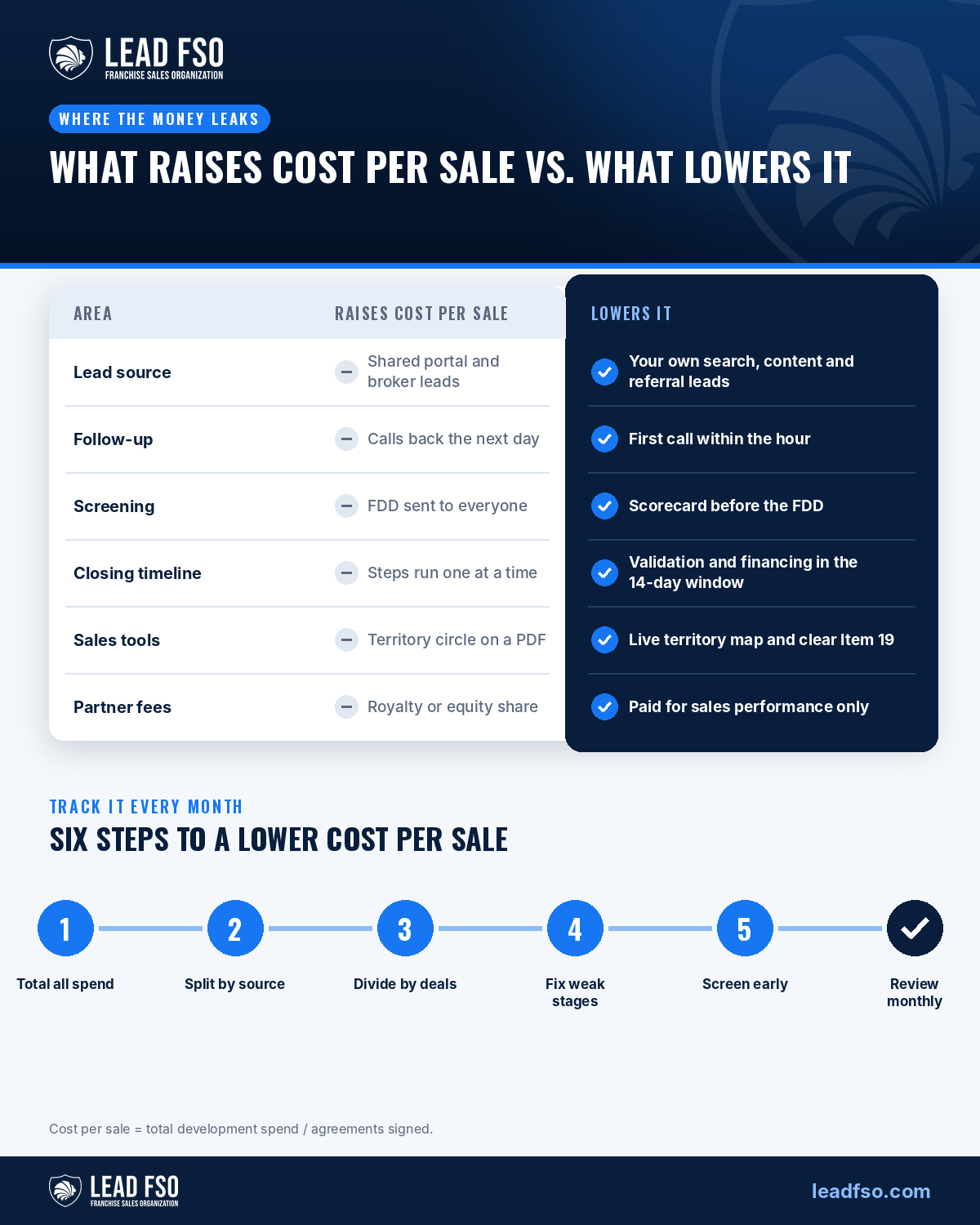
- Weak conversion between stages. The 2025 AFDR found that only about 2.3% of leads and 10% of qualified leads became sales in 2024. Losing a few points at any one stage raises the cost of every deal that does sign. (Our franchise sales pipeline metrics guide shows how to find the leak.)
- Slow follow-up. Paid leads that wait a day for a call cool off fast. See why the first hour matters.
- Buying leads instead of making them. Portal and broker leads are shared or expensive. Brands that create their own demand through search, content and referrals usually pay less per signed deal.
- Long closing cycles. At almost 20 weeks on average, every extra month a candidate sits in the pipeline adds rep time, follow-up and the risk they buy something else.
- Weak sales tools. A vague FDD, no Item 19 and territories shown as a circle on a PDF all slow candidates down. A clear Item 19 and real territory maps remove the questions that stall deals.
- Disqualifying too late. Candidates who can’t fund the deal or don’t fit the role still use up discovery day budget if nobody screens them early.
How to Lower Your Cost Per Franchise Sale
1. Track it monthly, by source
Split spend and signed deals by lead source: paid search, social, portals, brokers, referrals, trade shows. A blended average can hide one channel that costs three times as much per sale as the others.
2. Fix conversion before you add spend
Doubling your ad budget at a 1% close rate doubles your cost. Raising qualified-to-sale conversion from 10% to 13% lowers cost per sale by almost a quarter with the same spend.
3. Screen earlier
Use a short candidate scorecard on liquid capital, timeline and role fit before anyone gets an FDD or a discovery day invite.
4. Shorten the close
Plan the steps after FDD delivery in parallel instead of one at a time: validation calls, financing conversations and territory selection can all happen during the 14-day waiting period. Our guide from FDD receipt to signed agreement lays out the timeline.
5. Treat broker deals as a separate budget line
Brokers can be worth it for some brands, but compare their cost per sale against your own channels honestly. Our broker network playbook covers how to manage the channel without letting it take over your budget.
6. Don’t pay forever for one sale
Some sales partners take a royalty share or equity in your brand. That fee never shows up in cost per sale, but it costs you every year the franchisee operates. Read the fine print in your FSO contract terms.
Outsourced vs. In-House: Comparing the Real Cost
Many franchisors compare an FSO’s fee to a sales hire’s salary and stop there. That misses most of the cost. An in-house team also needs lead generation spend, CRM and tools, management time and months of ramp-up before the first deal signs. The 2025 AFDR showed the average franchisor planning about $1 million in total development budget, including salaries and marketing, for 2025.
The useful comparison is cost per signed agreement, not monthly fee. Ask any partner, in-house or outsourced:
- Who pays for the leads, and who owns them?
- Who does the closing: you or them?
- Is there any royalty, equity or ongoing share of franchisee revenue?
- What will you see each week: pipeline, stage conversion and spend?
Most traditional FSOs charge a retainer plus a commission and leave the closing to the franchisor. That means you still carry the conversion risk, which is the biggest driver of cost per sale.
How Lead FSO Keeps Cost Per Sale Predictable
Lead FSO was built around the cost per franchise sale, not the cost per lead.
- We make our own leads. Our sister company Lead PPC has managed more than $50 million in franchise ad spend for 500+ brands, at an average cost per lead of about $32. We don’t resell shared portal leads.
- We close the deals. Dedicated, named franchise development reps work each candidate from first call to signed agreement, and you get a weekly call on the numbers.
- No royalty or equity cut. You pay for sales performance. You keep 100%% of your company and your royalty stream.
- Tools that shorten the close. Our Explorer + Hub platform gives candidates a private Territory Explorer with real Item 19 numbers and available territories, and gives your team a live view of the pipeline and signed documents.
- We take emerging brands. Express Mobile Lube has grown to 30+ territories since February 2026, and Deer Solution has about 22 franchisees and 50+ territories sold. Both started with one to three locations.
If you want to know what your cost per franchise sale should be, we’ll walk through your current numbers with you.
Frequently Asked Questions
What is a good cost per franchise sale?
There is no single right number, but the Annual Franchise Development Report put the average at $13,757 per sale in 2024 among franchisors that track it. Brands that beat their sales goals spent about $18,983 per non-broker sale. Your own trend over time is the better guide.
How do you calculate cost per franchise sale?
Add up all franchise development spend for a period, including lead generation, broker and FSO fees, sales salaries and commissions, software and discovery day costs, then divide by the agreements signed in that period.
Why do broker sales cost more?
Brokers charge a success fee per deal, which averaged $34,095 in the 2025 AFDR, plus memberships and conference costs. The report put the average cost per broker sale at $48,903.
How can franchisors lower cost per franchise sale?
Track it by lead source, improve stage-to-stage conversion before adding spend, screen candidates earlier, shorten the closing timeline and avoid partners that take a royalty or equity share.
How does Lead FSO price franchise sales?
Lead FSO generates its own leads and closes the deals with a dedicated rep, and it never takes a royalty percentage or equity in your brand. Contact us for pricing based on your brand and territory plan.
Need Help?
If you’re considering enhancing your franchise sales strategy and driving quality leads, reach out to us through our Contact Us form. Let’s explore how we can support your franchise’s growth.