





A retired Army logistics officer fills out your form at 10 p.m. He has run teams of 60, managed budgets, and wants to own something of his own. Your rep calls back four days later, reads a generic script and asks him to “tell me about your management experience.” He’s polite, and he signs with a brand that called him the next morning, offered a veteran discount and talked to him like the operator he is. Veteran franchise recruitment is one of the best-fit candidate channels in franchising, and most franchisors treat it as an afterthought. This guide covers how franchisors can attract, qualify and close veteran candidates the right way.
Key Takeaways
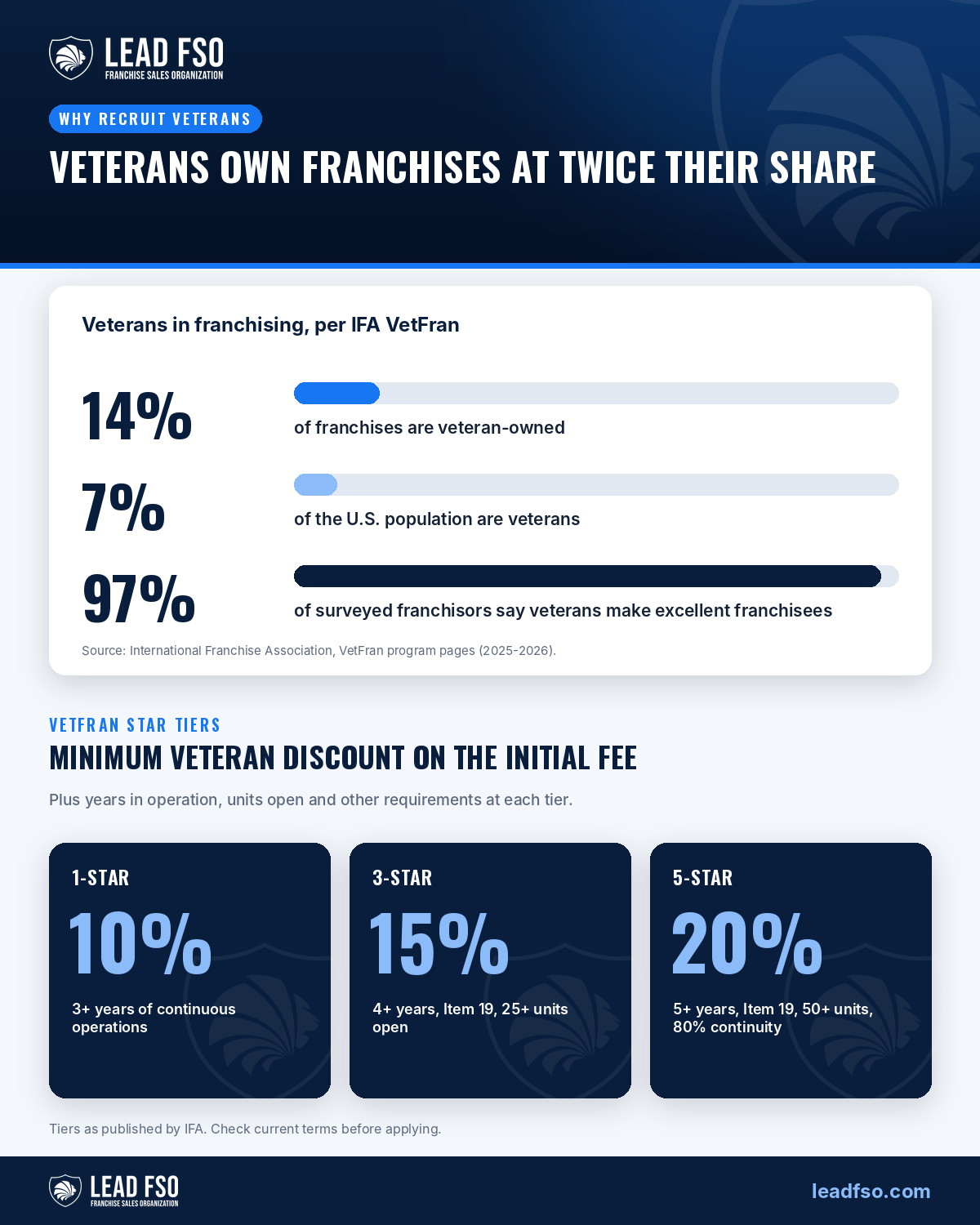
- Veterans are overrepresented in franchise ownership: the IFA’s VetFran program reports that about 14% of franchises are veteran-owned, while veterans are about 7% of the U.S. population.
- VetFran membership requires a discount on the initial franchise fee for honorably discharged veterans, with star tiers that start at a 10% minimum discount.
- Any veteran discount or incentive belongs in your FDD (Item 5), applied consistently, and reviewed by franchise counsel.
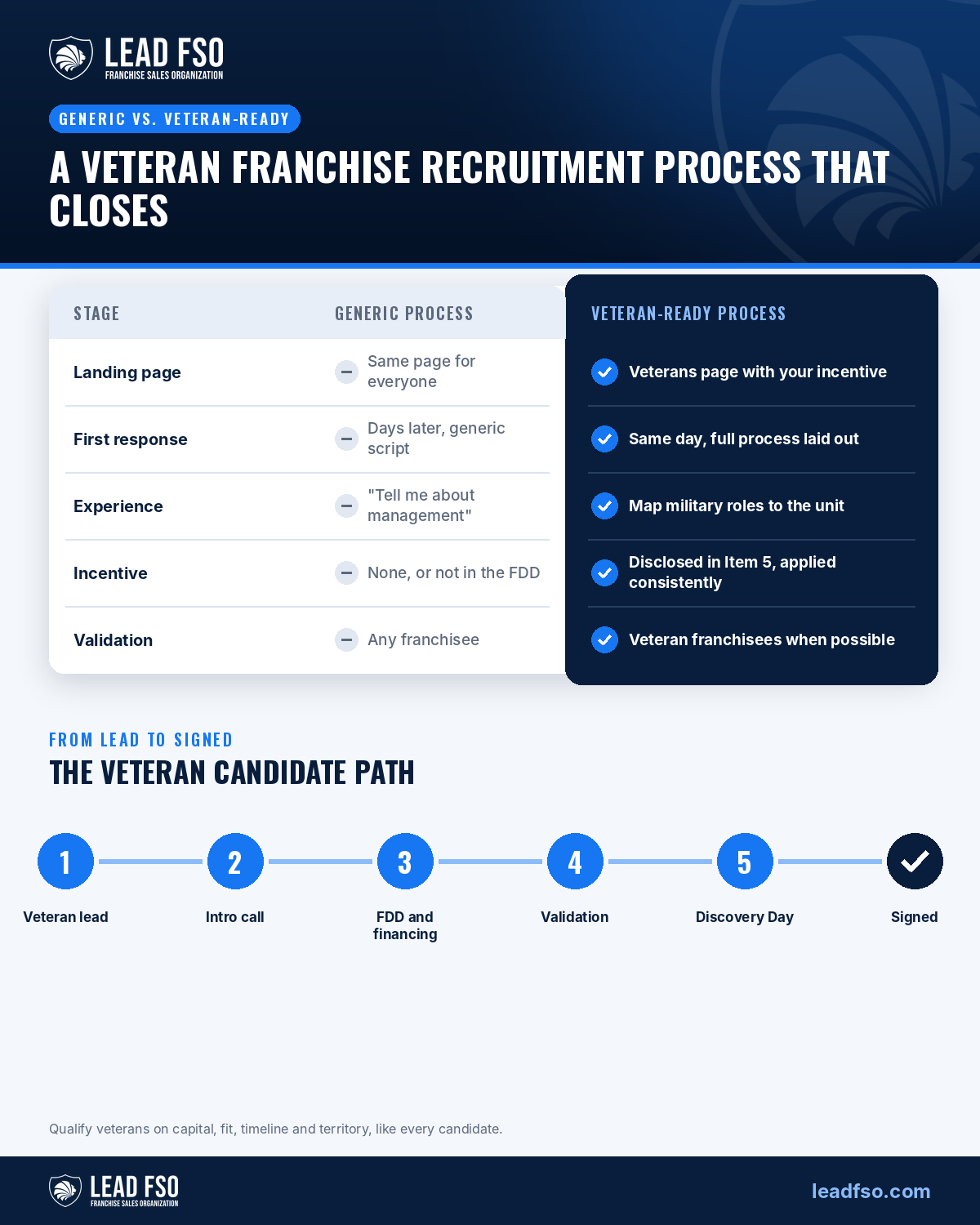
- Veteran franchise recruitment works best with a dedicated landing page, fast follow-up, a process that values military experience and a clear path through financing.
- Track veteran candidates as their own lead source so you can see what they cost and how they close.
Disclaimer: This article is operational, franchisor-side sales guidance, not legal advice. Have your franchise counsel review any discount, incentive or FDD change before you offer it.
Why Veteran Franchise Recruitment Belongs in Your Development Plan
Franchising and military service share a lot. A franchise system hands an owner a proven playbook, a chain of support and standards to execute. Veterans have spent years doing exactly that.
What the data says. The International Franchise Association’s VetFran program reports that veterans make up about 7% of the U.S. population but own about 14% of franchises. In IFA’s surveys, 97% of franchisors said veterans make excellent franchisees, and 70% said they had brought on a veteran franchisee or corporate employee in the past year.
What veterans bring to a franchise:
- Systems discipline. They follow the operations manual instead of reinventing it.
- Leadership. Many have hired, trained and led teams under pressure, which is the hardest part of running most units.
- Mission focus. They tend to commit to a plan and work it.
- A network. Veteran owners refer other veterans, and they make credible validation calls.
None of that guarantees success, and veterans should be qualified the same way as every candidate: capital, fit, timeline and territory. But as a lead source, veterans often convert well because the brand and the buyer want the same things.
How VetFran Works for Franchisors
VetFran is the IFA’s long-running veterans initiative, started in 1991 by Don Dwyer Sr., founder of The Dwyer Group, after the Gulf War. It connects veterans with franchise brands that offer them incentives.
The basic requirement. To join, a franchisor offers a discount on its initial franchise fee to honorably discharged veterans. IFA also encourages brands to add other incentives.
The star tiers (as published by IFA):
- 1-Star: IFA member in good standing, clean audit report, at least a 10% initial fee discount and 3+ years of continuous operations.
- 3-Star: at least a 15% discount, 4+ years of operations, an Item 19 financial performance representation and 25+ units open.
- 5-Star: at least a 20% discount, 5+ years, Item 19, 50+ units open, a minimum 80% continuity rate over three years and at least one Certified Franchise Executive on staff.
IFA notes that star ratings are not a guarantee of profitability. Membership gives brands directory listing, a member badge and visibility in VetFran programming. Requirements change, so check the current terms with IFA before you apply.
Designing a Veteran Incentive That’s Compliant and Worth Something
A discount is the entry ticket, but the best veteran programs think about what actually helps a veteran get open.
Incentive options to consider:
- A percentage off the initial franchise fee (the VetFran baseline).
- A larger discount for a second unit or an area development agreement.
- Reduced or deferred fees for a set period after opening.
- Extra training, mentoring from an existing veteran franchisee, or help with lender introductions.
Compliance checkpoints:
- Put it in the FDD. Item 5 covers initial fees, and discounts and ranges generally need to be disclosed. Have counsel add the veteran program before you advertise it.
- Apply it consistently. Define who qualifies (for example, honorably discharged veterans, and whether you include spouses or reservists) and how they prove it, such as a DD-214.
- Check state rules. In franchise registration states, fee changes and new incentives may require an amendment or filing.
- No earnings talk. Veteran-focused marketing still can’t make financial performance claims outside Item 19. Our franchise Item 19 guide covers what reps can and can’t say.
Where to Find Veteran Franchise Candidates
Veterans search for franchises the same way other candidates do, plus a few channels that are all their own.
- Your own website. A dedicated veterans page with your discount, a short story from a veteran owner (with permission) and a form that tags the lead as veteran. Use it as the landing page for every veteran campaign.
- Paid search and social. Search terms like “franchise for veterans” and “veteran franchise discount” carry clear intent. Military-interest audiences on social can work for awareness, but measure them on signed deals, not leads.
- VetFran and IFA listings. The VetFran directory puts you in front of veterans already looking at franchising.
- Transition programs and veteran organizations. Many installations and veteran groups run entrepreneurship and transition events. Show up as an educator, not a pitch.
- Brokers. Some franchise brokers specialize in transitioning service members. Tell your broker network about your program; see our broker network playbook.
- Your veteran franchisees. Referrals from current owners are often the highest-quality source of all.
Qualifying and Closing Veteran Candidates
The process should be the same as for any candidate, adjusted for how veterans like to make decisions.
Speed and structure. Respond fast, then lay out the full process on the first call: steps, timeline, what you need from them and what they get from you. A clear plan builds trust. Our article on franchise lead response time shows why the first hour matters.
Translate the experience. Ask about the roles they held, the size of the teams they led and the budgets they managed. Then show how that maps to running your unit. Don’t assume every veteran is an owner-operator fit; ask.
Capital and financing. Many veterans are financially ready; some need help. Introduce lenders who know franchising, and make sure candidates understand the investment in Item 7. Our candidate financing handoff guide covers how to do that cleanly. Ask lenders about current SBA options for veterans, since program details change.
Validation and Discovery Day. Connect veteran candidates with veteran franchisees during validation when you can. At Discovery Day, let them meet the people who will support them after opening.
Measuring Your Veteran Franchise Recruitment Program
Treat veterans as their own lead source so you can manage the program on facts.
- Leads and cost per lead by channel (website, paid, VetFran, brokers, referrals).
- Stage conversion: lead to intro call, FDD sent, Discovery Day and signed agreement.
- Cost per franchise sale after the discount, compared with your other sources.
- Time to open and early unit performance for veteran franchisees, compared with the rest of the system.
If veteran deals close at a healthy rate and open on time, the discount is a smart acquisition cost, not a giveaway. Our guide to franchise sales pipeline metrics shows how to set up that reporting.
How Lead FSO Runs Veteran Franchise Recruitment
Lead FSO is a full-funnel franchise sales organization. We generate our own leads, veterans included, and our reps close the deals.
- Veteran campaigns. We build veteran landing pages and paid campaigns around your program and tag every veteran lead in the pipeline.
- Dedicated reps. Your named franchise development rep works veteran candidates from first call to signed agreement and walks through results with you on a weekly call.
- The Explorer + Hub. Candidates explore real Item 19 financials and open territories in the Territory Explorer, and your team tracks every prospect and signed document in the Hub.
- No royalty or equity cuts. You keep 100% of your company and your royalty stream.
- Emerging brands welcome. Express Mobile Lube has reached 30+ territories since February 2026, and Deer Solution has about 22 franchisees and 50+ territories sold. Both started with one to three locations.
Frequently Asked Questions
What is veteran franchise recruitment?
It’s a focused effort to attract, qualify and sign military veterans as franchisees, usually with a veteran incentive, dedicated marketing and a sales process built around how veterans evaluate opportunities.
How many franchises are owned by veterans?
The IFA’s VetFran program reports that about 14% of franchises are veteran-owned, even though veterans make up about 7% of the U.S. population.
What do franchisors need to offer to join VetFran?
A discount on the initial franchise fee for honorably discharged veterans. IFA’s current star tiers start at a minimum 10% discount and go up to 20% for 5-Star brands, with added requirements such as years in operation, units open and an Item 19.
Does a veteran discount have to be in the FDD?
Fee discounts are generally disclosed in Item 5 of the FDD, and in registration states a new incentive may require an amendment. Have franchise counsel add and review the program before you advertise it.
Where do franchisors find veteran franchise candidates?
The best sources are a dedicated veterans page on your website, paid search, the VetFran directory, transition and veteran organizations, brokers who specialize in veterans, and referrals from your current veteran franchisees.
Can Lead FSO run veteran recruitment for my brand?
Yes. Lead FSO builds veteran campaigns and landing pages, generates and tags veteran leads, and has dedicated reps work those candidates through to a signed agreement, with a weekly call to review results.
Need Help?
If you’re considering enhancing your franchise sales strategy and driving quality leads, reach out to us through our Contact Us form. Let’s explore how we can support your franchise’s growth.