





Your best candidate of the quarter lives in Chicago. She has the capital, the experience and a spouse who is on board, and she wants to sign before the end of the month. Then your counsel asks one question: is the Illinois registration current? It lapsed during renewal season, and until it is effective again, nobody on your team can offer or sell her a franchise. Franchise registration states turn compliance dates into sales dates. This guide shows franchisors how the franchise registration states work, where they trip up a sales calendar, and how to plan development so a lapsed filing never costs you a signed deal.
Key Takeaways
- In a franchise registration state, offers and sales are both off limits until the registration (or required notice filing) is effective, not just the signing.
- The commonly listed registration states are California, Hawaii, Illinois, Indiana, Maryland, Michigan, Minnesota, New York, North Dakota, Rhode Island, Virginia, Washington and Wisconsin; several others require a filing or notice. Lists differ by source, so let counsel confirm yours.
- The FDD must be updated within 120 days after fiscal year end, and each state renews on its own schedule. Renewal season is when sales in registration states quietly stall.
- Some states add earlier disclosure timing, franchise seller disclosure forms, advertising filings and broker registration. Your sales team, brokers and ads all need to know the rules by state.
- Build a state-by-state sales calendar: where you can sell today, what renews when, and which candidates are waiting on which state.
Disclaimer: This article is operational, franchisor-side sales guidance, not legal advice. State franchise laws differ and change. Have your franchise counsel confirm registration, renewal and exemption status for every state where you sell.
What Are Franchise Registration States?
The FTC Franchise Rule sets the national floor: deliver your Franchise Disclosure Document (FDD) at least 14 calendar days before a candidate signs a binding agreement or pays you anything. It does not require you to register with the FTC. A group of states goes further. They require franchisors to register the FDD with a state regulator, or make a formal filing, before offering or selling franchises there.
The commonly listed registration states:
- California, Hawaii, Illinois, Indiana, Maryland, Michigan, Minnesota, New York, North Dakota, Rhode Island, Virginia, Washington and Wisconsin.
- Some law firm summaries treat Indiana, Michigan and Wisconsin as annual notice filings rather than full registration reviews, and some add Connecticut or Louisiana depending on trademark status. That is exactly why your list should come from your counsel, not a blog post.
Filing and notice states. A second group, often listed as Connecticut, Florida, Kentucky, Nebraska, North Carolina, South Carolina, South Dakota, Texas and Utah, requires a business opportunity exemption notice or filing, often depending on whether your principal trademark is federally registered. These filings are usually lighter, but missing one can still put sales at risk.
Why it matters for sales, not just legal. Registration states include some of the largest franchise markets in the country: California, New York and Illinois alone hold a big share of candidates for most consumer brands. A brand that is not registered there is not just “less compliant.” It is closed for business in markets its ads, brokers and portals are already reaching.
How Registration Rules Affect Your Franchise Sales Process
The biggest misunderstanding we see with emerging franchisors is thinking registration only matters at signing. In a registration state, the prohibition usually covers the offer too.
What “offer” can include:
- Sending an FDD or franchise agreement to a resident of that state.
- Running franchise recruitment ads targeted at that state.
- A sales call that pitches a specific territory in that state.
- A broker presenting your brand to a candidate who lives there or wants a territory there.
State laws define offers differently, and some look at both where the candidate lives and where the franchised business will operate. A Texas resident who wants a territory in California can still trigger California’s law. Your CRM should capture both the candidate’s residence and the target territory state, then flag either one if it is in a registration state.
Disclosure timing can be earlier than 14 days. Some state rules require disclosure earlier than the federal rule. Michigan and New York, for example, have historically required the FDD earlier in certain circumstances, such as New York’s rule tied to the first personal meeting. Build the strictest timing into your process, and track receipt carefully. Our guide to the FDD receipt to signed agreement timeline covers how to keep that window moving.
Franchise seller disclosure forms. Several registration states require a franchise seller disclosure form that names every person who sells your franchise, including outside reps. If you add a new closer or work with an outside sales team, counsel may need to update those forms before that person sells in those states.
Renewal Season: The Hidden Franchise Sales Freeze
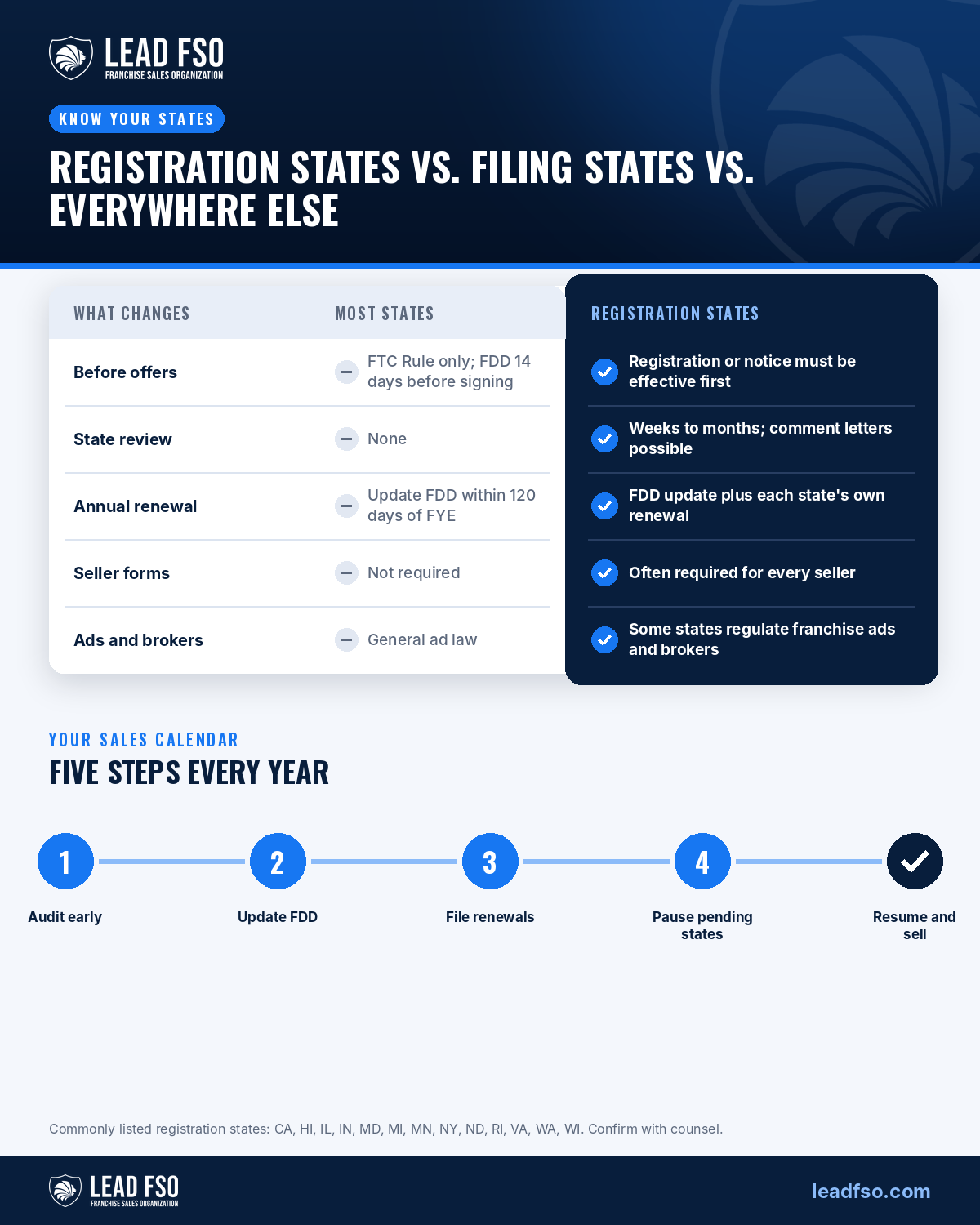
Every franchisor has to update its FDD within 120 days after its fiscal year end. For a calendar-year franchisor, that lands around the end of April. Registration states then renew on their own schedules, and state review can take anywhere from a few weeks to a few months depending on the state and the season.
Where deals stall:
- The FDD goes stale. Once the 120-day mark passes, you generally can’t keep using last year’s FDD. If the new one isn’t ready, sales pause everywhere, not just in registration states.
- States lag. A state can still be reviewing your renewal after other states have cleared. Candidates in that state wait.
- Comment letters. Merit-review states can send comment letters asking for changes, and each round costs time.
- Financial audits. Audited financial statements usually drive the timing. A late audit means a late FDD, and a late FDD means a late renewal.
What strong franchise development teams do about it:
- Start the audit and FDD update early, so renewals are filed well before the deadline.
- Map the deals in the pipeline by state 60 to 90 days before renewal, and push candidates in registration states toward signing while the current registration is effective, without pressure tactics.
- Pause paid recruitment ads in any state whose registration is pending, and turn them back on the day it’s effective.
- Tell brokers which states are paused. Nothing burns a broker relationship faster than a candidate they can’t sell.
Pipeline visibility matters here. If you track the franchise sales pipeline metrics that matter, you can see exactly how many candidates are waiting on each state and what that wait is costing you.
Franchise Registration States and Your Lead Generation
Most franchise lead sources don’t know or care where you’re registered. Portals, social ads and search campaigns will happily send you candidates from every state. That creates two problems: wasted spend and compliance risk.
Paid ads. Exclude states where you can’t sell yet, or where a renewal is pending. Several registration states, including California, New York, Maryland, Minnesota, North Dakota and Washington, have historically had rules on franchise advertising, including filing ads before use in some cases and restricting claims. Ask counsel whether your landing pages, social ads and emails count as franchise advertising in those states.
Portals and brokers. Give every portal and broker a current list of states you can sell in. Some states also regulate franchise brokers directly; New York and Washington, for example, have required broker registration. Our franchise broker network playbook covers how to keep broker groups aligned.
Territory tools. If your territory map shows open markets in a state where you aren’t registered, candidates will ask for them. Tie territory availability to registration status, so a market only shows as open when you can actually sell it. See how we approach this in our franchise territory mapping guide.
Exemptions: When You May Not Need to Register
Many registration states have exemptions, but they’re narrower than most founders hope. The most common is a large franchisor exemption for brands with a high net worth (thresholds of $5 million, $10 million or $15 million appear in different states) and real experience in the business. Others cover sales to experienced or high-net-worth franchisees, large investments, or fractional franchises.
What that means for emerging brands:
- Most emerging franchisors won’t qualify for net worth exemptions yet, so plan to register.
- An exemption is a legal call, made state by state. Don’t let a sales rep decide a deal is exempt.
- Even when a state exempts the registration, other rules, like disclosure timing and anti-fraud provisions, usually still apply.
For brands at this stage, our article on selling emerging franchise brands covers how to build momentum before you can sell everywhere.
Building a State-by-State Franchise Sales Calendar
A sales calendar turns registration rules into something your whole team can act on. It doesn’t need to be complicated. It needs to be current.
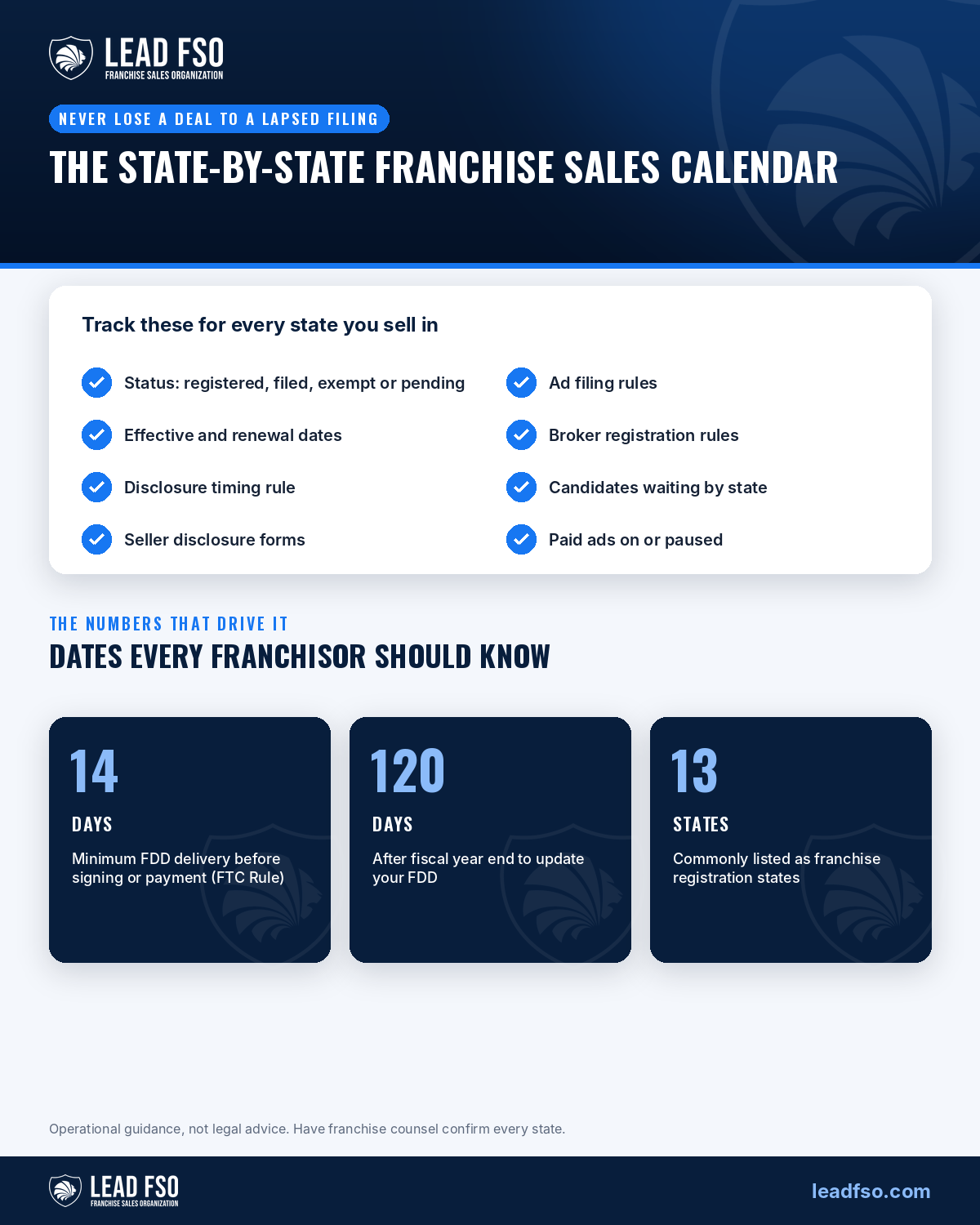
What to track for every state:
- Status: registered, notice filed, exempt, pending or not available.
- Effective date and renewal or expiration date.
- Disclosure timing rule, if stricter than the federal 14 days.
- Seller disclosure form status for each person selling.
- Advertising filing rules and broker registration rules.
- Candidates in the pipeline from that state, and their expected decision dates.
Who owns it. Franchise counsel owns the legal status. Your franchise development lead owns the calendar and makes sure sales, marketing and brokers see changes the same day. Review it at least monthly, and weekly during renewal season.
Plan expansion with it. Registering in a new state takes filing fees, state review time and, sometimes, changes to your FDD. Add a state when your lead data shows real demand, not because a single candidate asked. Your cost per franchise sale should include those registration costs.
How Lead FSO Helps Franchisors Sell Across Registration States
Lead FSO is a full-funnel franchise sales organization. We generate our own franchise leads and close the deals, and we build state rules into how we do both.
- Lead generation by state. Our campaigns target the states where you can sell today, and we adjust as registrations renew or new states come online.
- Dedicated reps with a weekly call. Your named franchise development rep tracks every candidate by state, flags renewal timing early and reviews the pipeline with you every week.
- The Explorer + Hub. Our Territory Explorer shows candidates real Item 19 financials and available territories, and the Team Hub keeps territories, prospects and signed documents in one place, so a market only goes live when you can sell it.
- No royalty cuts. We don’t take a percentage of your royalties or equity in your company. You keep ownership; we get paid for sales.
- We take emerging brands. Express Mobile Lube has grown to 30+ territories since February 2026, and Deer Solution has about 22 franchisees and 50+ territories sold. Both started with one to three locations.
Frequently Asked Questions
What are the franchise registration states?
The commonly listed franchise registration states are California, Hawaii, Illinois, Indiana, Maryland, Michigan, Minnesota, New York, North Dakota, Rhode Island, Virginia, Washington and Wisconsin. Several more require a notice or exemption filing. Sources classify some states differently, so confirm your list with franchise counsel.
Can I talk to a candidate in a registration state before my registration is effective?
Generally, no offers or sales are allowed until registration is effective, and an offer can include sending an FDD, pitching a territory or targeting ads at that state. Ask counsel exactly what your team can and can’t say while a filing is pending.
How often do franchise registrations renew?
Registrations renew annually, on each state’s own schedule. Separately, your FDD has to be updated within 120 days after fiscal year end, so renewal season usually falls in spring for calendar-year franchisors.
Do franchise ads need to be filed in registration states?
Some registration states have historically required franchise advertising to be filed before use or restricted certain claims. The rules vary, and internet ads may be treated differently, so have counsel review your ads and landing pages for the states you target.
Are emerging franchisors exempt from registration?
Usually not. The most common exemptions are for large franchisors with high net worth and experience, or for certain large or sophisticated buyers. Most emerging brands should plan to register in the states where they want to sell.
How does Lead FSO handle registration states?
Lead FSO targets its lead generation to the states where a brand can sell, tracks every candidate by state, and flags renewal timing in the weekly call with your dedicated rep, so deals don’t stall on a lapsed filing.
Need Help?
If you’re considering enhancing your franchise sales strategy and driving quality leads, reach out to us through our Contact Us form. Let’s explore how we can support your franchise’s growth.